
Description
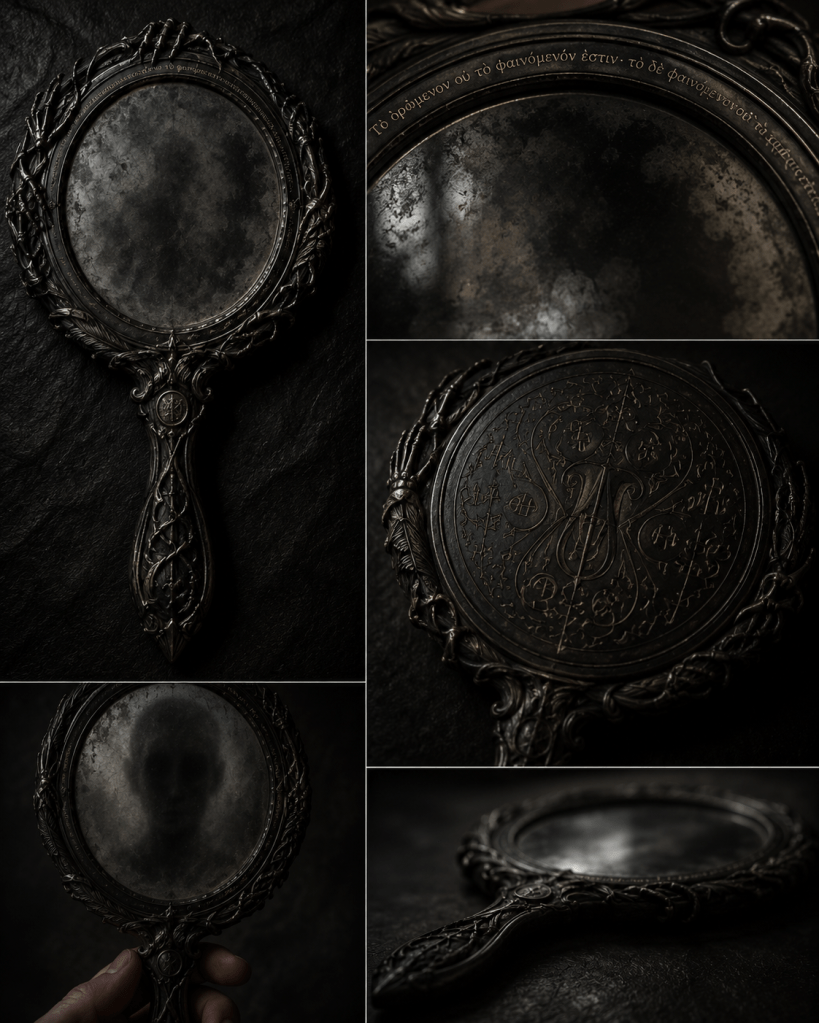
At first glance the artifact appears to be an antique hand mirror dating from the late nineteenth century.
Its frame is fashioned from tarnished silver-black metal that never quite reflects light correctly. Intricate patterns resembling intertwined vines, feathers, and skeletal fingers spiral around its circumference. Tiny symbols have been engraved into the reverse side, though none belong to any known alphabet.
The glass itself is unsettling.
Even when perfectly clean it appears slightly cloudy, as though viewed through a thin layer of smoke. Those who stare into it for long periods often report seeing movement within the silver backing.
The mirror is cold to the touch regardless of its surroundings.
Attempts to photograph its reflection invariably fail. Images appear blurred, overexposed, or develop unexplained distortions.
The mirror bears a nearly invisible inscription along its inner frame:
Τὸ ὁρώμενον οὐ τὸ φαινόμενόν ἐστιν· τὸ δὲ φαινόμενον οὐ τὸ κεκρυμμένον ἐστίν.
Ancient greece “What is seen is not what appears; and what appears is not what is hidden.”
No record identifies its creator.
Among occult collectors it is known as the Mirror of the True Visage.
Function
The Mirror reveals aspects of a subject concealed by the Illusion.
It does not show objective truth.
Rather, it reveals the nature that lies beneath the mask reality imposes.
Shapeshifters, angels, demons, ghosts, and other entities capable of disguising themselves often appear differently when viewed through the mirror.
The effect is subtle at first.
Colors fade.
Background details blur.
Then the hidden form emerges.
The transformation occurs only within the reflection.
Observers looking directly at the subject perceive nothing unusual.
Thomas Dumiroir
Should Thomas examine his own reflection in the Mirror of the True Visage, he encounters something deeply disturbing.
At first the mirror displays his ordinary face.
Then the image begins to deteriorate.
The edges blur.
Features smear and shift.
The eyes drift slightly out of alignment before correcting themselves.
The nose changes shape from one blink to the next.
The mouth appears different every time he attempts to focus upon it.
No matter how long he studies the image, the face never resolves into a stable form.
It is as though something is deliberately concealing the reflection.
Or perhaps something has been removed from it.
Those observing over Thomas’s shoulder see the same phenomenon.
The mirror refuses to reveal what lies beneath.
The Valet
When Thomas eventually turns the mirror toward his valet, the illusion peels away almost instantly.
The reflected figure remains recognizably human for a moment.
Then vast white wings emerge behind him.
A halo of soft golden radiance surrounds his head.
The eyes become pools of living light.
The clothing transforms into robes woven from impossible brilliance.
The figure appears solemn rather than benevolent.
Ancient rather than kind.
Powerful beyond comprehension.
Yet throughout the transformation the reflected being remains perfectly calm.
As though it has nothing to hide.
Or has known this moment would come.
The Driver
The driver’s reflection changes more violently.
The human image fractures.
Darkness spreads through the mirror like spilled ink.
Horn-like shapes emerge from the silhouette.
The eyes ignite with ember-red light.
Shadowy wings unfurl behind the figure.
The mouth appears slightly too large.
The smile slightly too sharp.
Ancient scars and infernal symbols become visible beneath the skin.
Yet unlike popular depictions of demons, the reflected being appears composed.
Almost aristocratic.
The expression suggests amusement rather than malice.
As though the revelation confirms something the driver has long known.
Limitations
The mirror cannot reveal everything.
Certain entities appear distorted, fragmented, or completely obscured.
Powerful beings may produce contradictory reflections.
Some appear as shifting collections of impossible images.
Others show only darkness.
A few display nothing at all.
The mirror’s greatest limitation is that it reveals only what the observer is capable of perceiving.
Truth too large for the mind remains hidden behind symbols and approximations.
Keeper’s Notes
The Mirror of the True Visage serves as an investigative tool rather than a source of definitive answers.
Its revelations should create questions rather than solve them.
Most importantly, Thomas’s obscured reflection should remain unexplained.
At least for now.
The player should immediately recognize that the mirror is capable of revealing angels and demons.
The fact that it fails to reveal Thomas is therefore far more unsettling than any monstrous reflection could ever be.
 Ignis Aeternus WH 40K campaign notes