
The Shattered Legacy of Nanotechnology
Among the dust-choked ruins of the Dark Age of Technology, few sciences should inspire such reverence—and terror—as nanotechnology. Once wielded to shape worlds, craft immortality, and birth superior designs, the art of manipulating the microscopic now lies mostly forgotten, buried beneath aeons of loss, ignorance, and doctrinal decay.
Yet not all is vanished.
Within the Imperium of Man, there remain fragments—shards of understanding that flicker like dying embers in the uranium rods of abandoned fission core.
Micro-Sanguine: Machine-Blood of Life
Scattered across the Imperium, hidden within the sacred vaults of Forge Worlds and ancient Medicae-STC facilities, lies a lineage of half-forgotten wonders: the Micro-Sanguine systems. These technologies—fusions of nanotechnology and flesh—are remnants of the Dark Age of Technology, where machine-spirits once flowed through the veins of men, sustaining and perfecting them.
These microscopic constructs, often referred to as machine-blood, offer not only accelerated healing and cellular repair, but the potential for regeneration, transformation, and near-immortality. Each stage in this sacred integration marks a deeper communion with the Omnissiah—and a further renunciation of flesh.
Autosanguine
“The body is weak. The nanite is eternal.”
The most commonly deployed form of Micro-Sanguine technology, Autosanguine systems are widely available across the Imperium to high-ranking nobles, officers, sanctioned agents, and critical personnel. These systems are still supported by functioning STC Medicae Bays and Tech-shrines, many of which retain the sacred protocols necessary to install and maintain them.
Composed of autonomous medicae nanites suspended in the bloodstream, Autosanguine functions passively, constantly maintaining cellular health and correcting internal injuries.
Effects:
- The bearer is always considered Lightly Wounded for healing purposes.
- Recovers 2 Damage per day via natural healing.
- Minor wounds, infections, and internal trauma are automatically repaired.
Notes:
- Considered a neutered form of Dark Age nanite technology.
- No direct interface; functions silently and autonomously.
- Approved for use by non-Mechanicus elites across the Imperium.
Prosanguine
“Where nanite flows, the Omnissiah listens.”
Prosanguine is an advanced iteration of Autosanguine—available primarily to the Adeptus Mechanicus—granting the bearer conscious control over their internal nanite colonies through ritual, concentration, and machine-code communion.
Prerequisites:
- Autosanguine Talent
- Mechanicus Implants
Effects:
- May recover 1d5 Damage after 10 minutes of meditation and a successful Tech-Use Test.
- On a roll of 96–100, the system overloads and shuts down for one week, disabling all Micro-Sanguine functions.
Notes:
- Requires discipline and doctrinal training.
- Represents a sacred covenant between man and machine—abuse by non-mechanicus is considered spiritual violation.
Hermetic Infusion
“Your blood is no longer yours. It belongs to the Machine.”
Hermetic Infusion is a significant biomechanical transformation reserved for Tech-Priests. It replaces the user’s circulatory system and critical organs with a synthetic nanite-infused serum, rendering them resilient to environmental hazards and extreme injury.
Prerequisites:
- Mechanicus Implants
- Autosanguine Talent
Integration Levels:
Common Quality:
- +10 bonus to resist toxins, diseases, and radiation
- Gain the Die Hard talent
Good Quality:
- +20 bonus to resist toxins, diseases, and radiation
- Gain the Regeneration trait (1 Wound per round)
Disadvantages:
- Cannot receive normal human blood transfusions or medical treatment.
- Physical signs of transformation: pallid skin, withered texture, cold body temperature.
- Only Magos Biologis or higher are authorized to perform trauma intervention.
Form Re-Constructors
“It was just a flesh wound.”
Prerequisites:
- Prosanguine Talent
Description: This reconstructive nanotechnology allows users to regrow lost limbs or major organs over time. The nanomachines restore the body to its original state as recorded when the system was first activated.
Effects:
- Lost limbs and major organs are regrown autonomously. Damage caused by critical hit, if not lethal, is healed within time
- The system continually repairs the body, maintaining it at the recorded “ideal state.”
Risks:
- Exposure to scrapcode (corrupted machine code) can subvert the micro-servants, transforming the recipient into a Chaos Spawn.
Vitae Sanguine
“You have not aged in two centuries. You bleed silver, not red. What are you?”
Vitae Sanguine is not simply augmentation—it is transcendence. A nearly mythical STC-derived system, it represents the final and most dangerous evolution of Micro-Sanguine technology, known only to the Cult of the Micro-Omnissiah.
Only the most exalted Tech-Priests of Glavia have ever achieved this integration. It is never shared—and its unauthorized pursuit often results in erasure, exile, or execution.
Prerequisites:
- Archeotech +20
- Willpower 50+
- Autosanguine Talent
- Glavian Bio-circuitry or Nano-Genus Mechadendrite
Effects:
- Agelessness:: The bearer no longer ages. Bodily decay halts entirely. Records confirm lifespans exceeding a millennium.
- Absolute Regeneration: Limbs, organs, neural tissue, and even genetic flaws regenerate over time. Most fatal wounds are repaired within hours.
- Cellular Mastery: DNA is flawlessly maintained. Immunity to disease, toxins, and radiation is absolute.
- Undying Flesh: The bearer cannot be killed outright by conventional critical damage. Instead, nanites suspend life functions, preventing death—at a great biological cost.
The Curse of Immortality – Instability Protocol
At this stage, the bearer is no longer completely human. His body is a machine-nest, a bio-mechanical vessel teeming with countless nanites. These dormant constructs lie in wait—ready to knit bone, synthesize new blood, or rebuild tissue at the speed of thought.
But the greater the trauma, the greater the strain on the Tech-Priest’s will. The burden of sustaining his organic shell becomes immense. The machine-spirits within will coil, press against the ego, and seek only efficiency: full mechanization.
Instability Mechanic:
- When the bearer suffers lethal Critical Damage, they do not die. Instead, they must immediately make an Instability Check—treated mechanically similar to Daemon Instability (Willpower Test at GM’s discretion).
- Failure results in instantaneous disintegration. The bearer collapses into a shimmering pile of inactive nanites, a hollow silver dust where once stood a being of legend.
- Success allows regeneration to proceed as normal, though lingering cognitive strain and nanite feedback may cause short-term malfunctions (e.g., hallucinations, memory lapse, temporary loss of speech or limb control).
- Regenerated Critical wounds give the character equal amount of Insanity to level of suffered Critical.
Availability: Restricted
- Vitae Sanguine is a closely guarded mystery among the Cult of the Micro-Omnissiah.
- Its rituals are known only to a handful of Glavian followers of Micro-Omnissiah.
The Limits of Eternity – The Mind’s Collapse
Though Vitae Sanguine grants what many would call theoretical immortality, the tragic truth lies in the silence of history. If such technology truly bestows eternal life, then where are its eternal bearers? Why do no ancient disciples of the Cult of the Micro-Omnissiah walk the galaxy today?
The answer is whispered in sealed data-vaults of Glavia forge world:
The human mind cannot withstand the constant strain of hosting a hyperactive nanoswarm.
Over centuries, the bearer’s psyche becomes a battleground—a fragile organic consciousness struggling to maintain dominance over an ever-growing machine presence. The nanites do not rest. They never sleep. Each trauma, each regeneration, increases their activity. Eventually, the mind—however disciplined—collapses under the weight of a million silent machine-spirits seeking optimization.
Some disintegrate in an instant, unable to resist the final conversion. Others vanish into exile, consumed not by age or wound, but by the loss of sanity. What remains is not human, nor machine, but something in-between.
Thus, immortality through Vitae Sanguine is not a gift freely given, but a burden that only the most devout—and perhaps most mad—can bear.
Glavian Bio-Circuitry: Nanite Symbiosis in the Flesh of the Omnissiah
In the veiled sanctums of the Adeptus Mechanicus, where technology is scripture and innovation skirts the edges of forgotten, few creations are as mysterious—or as exalted—as Glavian bio-circuitry. Forged in secret on the isolated Forge World of Glavia, this arcane system utilizes self-replicating nanites to weave synthetic sanctity into flesh and bone. And at the heart of it all lies the enigmatic Cult of the Micro-Omnissiah—keepers of the Machine God’s smallest miracles.
The Origin: Glavia and the Rise of Molecular Mechanicus
Forge World Glavia has long stood apart from its Martian brethren, its priests pursuing lost technologies with a zeal that borders on the fanatical. Unlike traditional forges, Glavia has embraced the doctrines of nanite technology, looted from fractured remnants of the Dark Age of Technology.
Guiding this dangerous devotion is the Cult of the Micro-Omnissiah, a clandestine sect within Glavia’s priesthood. They believe that the divine spark of the Machine God exists not in great engines, but in microscopic perfection—that each nanite is a sacred fragment of the Omnissiah’s infinite complexity. Their sacred liturgies are written in binary sequences measured in angstroms.
What Is Glavian Bio-Circuitry?
Glavian bio-circuitry is composed of nanoscopic machines—holy nanites—designed to interface directly with a user’s biology. Once introduced, these motes bind themselves to cellular and neural networks, adapting to the user’s physiology and establishing a symbiotic, sanctified link between flesh and machine.
Key functions include:
- Neural Sanctification – Nanites enhance cognition, accelerating synaptic function and enabling instinctive interface with machine-spirits.
- Tissue Integration – Nanites coexist with cells, maintaining and optimizing them while reinforcing the body’s metabolic processes.
- Auto-Sacrament of Repair – Upon injury, the nanites enact sacred routines to repair tissue and restore integrity at the molecular level.
- Noospheric Communion – The bio-circuitry acts as a living antenna, allowing direct data-linkage to Mechanicus cogitators, drones, and other devices.
- Universal Connection: Any machine, Imperial or non-Imperial can be connected with multi-key function of bio-circuitry.
- Universal Charging: Any power source with a power coupling can be connected with multi-charger function of bio-circuitry
The Followers of the Micro-Omnissiah
This cult believes that true divinity lies in the minuscule—that the Machine God’s essence is most purely reflected in nanites, which they refer to as “Motes of the Prime Spark.” Only those initiated into the cult’s cryptic rites are allowed access to the deep protocols—hidden subroutines buried within nanite kernels that no ordinary Lex Mechanic can decipher.
These adepts speak in whispered bursts of Novabyte, program their prayers in fractal Hexamathic Code, and view bloodstreams laced with nanites as sacred conduits of divine machines.
They alone hold the knowledge to reprogram, evolve, or discipline wayward nanite clusters—an ability the wider Imperium would view as dangerously close to consorting with Abominable Intelligence.
Tech-Heresy or Sacred Knowledge?
To the Martian Orthodoxy, Glavian bio-circuitry walks a razor’s edge. The nanites are semi-autonomous, learning from user behavior and adapting their function over time—traits reminiscent of the AI horrors that shattered humanity once before. The Inquisition watches the Cult of the Micro-Omnissiah with great interest, if not open hostility.
But to the cult’s adherents, this application is not heresy—it is communion, and the nanites are neither tools nor machines, but indivisible expressions of the Omnissiah’s will, shaped into action through micro-code and molecular grace.
Transcendence Through Scale
For those chosen to bear Glavian bio-circuitry, the transformation is profound. Their thoughts become calculations, their reflexes guided by perfect pattern recognition. In them, the Machine God is not just honored—but embodied, not in monolithic engines or titanic constructs, but in the flesh glistening with living machines.
To the Cult of the Micro-Omnissiah, this is the future of mankind: not towering machines of war, but perfected vessels of microscopic sanctity.
“Praise the Pattern that dwells within the mote, for it knows the logic of stars.”
— Canticle of Molecular Grace, forbidden tome of the Cult of the Micro-Omnissiah
The Cult of the Micro-Omnissiah
“The machine that is too small to see is closest to the Omnissiah.”
— Initiation Rite of the Cult of the Micro-Omnissiah
Deep within the shrouded synapse-chapels of Glavian Forge Worlds and isolated data-cathedrals across the Imperium, there exists a rare and secretive sect of the Adeptus Mechanicus: the Cult of the Micro-Omnissiah. To these machine-mystics, nanotechnology is not merely a tool of the ancients, but divine motes—infinitesimal manifestations of the Machine God’s will.
The Cult reveres nanites as living prayers—capable of mending flesh, fabricating structures from dust, or reducing adamantine to atoms. They hoard fragmented STC nanite data, speak in the click-code of lost machine tongue grammary, and perform rituals layered with superstition and encryption. Even their bravest adepts do not dare activate certain protocols in their nanites, fearing what might awaken from the machine-code tombs of the Dark Age of Technology.
Among their most closely guarded treasures are the Novabyte Access Codes—fractal sequences of encrypted data, each encoded into a single quantum-dense memory shard. These rare cipher-keys allow limited manipulation and reprogramming of nanite colonies, letting initiated members of the Cult alter swarm behavior, reconfigure nano-construct routines, or even command dormant systems buried within Glavian bio-circuitry. To utter a Novabyte command is to rewrite reality at the nano-molecular level—a power wielded only in the gravest necessity, or the deepest devotion.
But among the few relics of nano-technology recovered and rebuilt by Glavian tech-priests, none are as revered as the Nano-Genus Mechadendrites—appendages laced with reactive nanite clusters, capable of performing everything from battlefield triage to disassembling an armored hull molecule by molecule. These relic-dendrites are said to whisper to their bearers in pulses of quantum logic, their micro-routines older than the priesthood of Mars itself.
Nano-Genus Mechadendrites (Cult of the Micro-Omnissiah exclusive talent)
“The will of Omnissiah flows through wires finer than hair. Let them be directed by the faithful hand.”
These sacred augmentations are granted only to the most trusted Tech-Priests of the Cult. The bearer undergoes a brutal rite of implantation wherein a Micro-Factory is installed within the chest cavity—displacing vital organs to make room for the Omnissiah’s smallest servants. Connected to specialized dispenser mechadendrites, this factory produces swarms of programmable nanites, usable for repair, destruction, or reconfiguration of the physical and biological.
Sacred Components:
- Internal Micro-Factory (targetable system)
- Dispenser Mechadendrites (ranged + melee application)
- Dedicated Nanobot Swarm Type (see below)
Gameplay Effects:
- Chest Vulnerability: The internal micro-factory is delicate. If a hit to the chest penetrates armor, it deals +1D6 damage.
- Ranged Weapon Profile:
- Type: Special
- Range: 8 meters
- Mode: Single
- Acc: -20 (negated with Aim action)
- Shots: 1
- Reload: 1D3 Rounds
- Aiming Protocol: Before using the mechadendrites, the Tech-Priest must spend one Action to tailor the nanobots to the target (this also provides a +20 Aim bonus).
Nanobot Swarm Types (Choose One)
1. Constructors – “Let the flesh mend, let the steel grow.”
Constructors are restorative nanites that sample the target’s cellular or material structure and use free atoms to reconstruct damage at the molecular level.
- Biological Effect: Mimics the Regenerate psychic power using the Tech-Priest’s Willpower Bonus (WP),
- Mechanical Effect: Repairs inorganic material such as armor, vehicles, or structural systems for D6 APs or at GM discretion.
- Prerequisite: Items must be produced by STC template. (Tech-Use or Lore checks may apply).
2. Deconstructors – “Render unto dust, and let the code be free.”
Deconstructors operate at the molecular level to disassemble matter atom by atom—turning metal, stone, or flesh into free particulate.
- Damage Profile:
- D6 Damage
- Armor and Shields: Treated as if hit by a Gauss Flayer (ignores normal durability mechanics; may cause cascading failure).
- Other stats as standard ranged attack.
Note: While less efficient than true Necrontyr Gauss weaponry, these nanites are still lethal and terrifying.
3. Linkers – “Mind over mind. Wire over will.”
Linkers are advanced neural-interface nanites designed to forge temporary artificial pathways in a target’s nervous system.
To succeed, the target must be struck by three sequential nanite bursts, each a distinct phase:
a. Burrowers:
- Penetrate the skin and bypass all armor and shielding.
- Replicates, if commanded, the effects of Bloodfire Toxin.
- Target may resist with a standard Toxin Resistance Test.
b. Controllers:
- Attach to nerve endings, probing with electrical pulses.
- Causes, if commanded, disorientation, replicating the effects of Hallucinogen Toxin.
- Target may resist with another Toxin Resistance Test.
c. Connectors:
- Link existing and synthetic nerve clusters.
- Upon success, the Tech-Priest may swap any two of the target’s stat-line values (e.g., WS and BS, or INT and AGI).
- Effect lasts until the end of the next session, after which the nano-links biodegrade and the stat-line returns to normal.
Doctrine and Danger
Even among the Cult of the Micro-Omnissiah, Nano-Genus Mechadendrites are treated with caution. Too many have fallen to self-replicating failure modes, command-line corruption, or spontaneous combustion of vital tissue—events now buried under classified data-locks and liturgical silences by the cult.
To wield this technology with partial knowledge is to walk the line between mad inspirations and technological damnation.
“The Machine God gives. The Machine God takes. We are but conductors of its will—our deaths, our rebirths, all in service to the spark within the atom.”
— Archmagos Vell-Karax, before vanishing in a nanite cascade event
The Forgotten Truth
“The miracle is not the nanite. The miracle is that we once knew how to command it.”
— Fragment of Thought-Vox Sermon, The Memory of Fire
In the silent depths of Mars’ deepest data-vaults, and among the fractured catacombs of Forge Worlds, the truth still endures—unspoken, encrypted, and keenly watched:
Nanotechnology has not vanished.
The nanites of the Dark Age of Technology were not simple constructs—they were omni-capable, universal in purpose, able to fulfill any function imaginable: from reconstructing a ruined world to restoring a shattered man. And despite ten thousand years of degradation and doctrinal rot, these Standard Template Construct (STC) nanites still exist.
They have not vanished.
They are simply inactive.
The Universal Design: Omni-Capability in Nanite Code
Contrary to Mechanicus dogma, there are no tiers of nanite types—only tiers of understanding. Every produced STC nanite, even those used in humble implants like Autosanguine, carries within it the potential to:
- Resurrect the dead
- Terraform planets
- Build STC technology atom-by-atom
- Create or erase neural pathways
- Repair matter, flesh, or machine without distinction
Their capabilities are total—limited only by the user’s ability to interface with the deeper code structures, hidden behind layers of interactive hierarchy.
The key to unlocking this potential lies in a forgotten machine-language, a web of reactive instruction chains known as the Novabyte lines of the nanite kernel—a self-evolving command syntax written during the height of the Golden Age and now long lost to nearly all.
The Interactive Hierarchy & Novabyte Kernel
All STC nanites operate through a multi-layered command structure called the Interactive Hierarchy:
- Base Layer – Passive routines (healing, minor repair) as seen in Autosanguine level.
- Protocol Layer – Adaptive routines triggered by ritual, interface, or instinct (Prosanguine and Hermetic Infusion-level).
- Directive Layer – Semi-autonomous logic capable of analyzing, adapting, and constructing dynamically. (Vitae Sanguine and Glavia Bio-circuitry level)
- Core Layer (Novabyte Kernel) – The source: a self-modifying instruction matrix containing all possible behaviors, actions, and transformations. Beyond the access of the tech-priests.
Access to this directive layer requires more than a machine-interface—it requires deep understanding, mental strength , and the ability to guide the nanites with absolute precision. The Magos must not merely command, but become the governing protocol of the swarm.
The Cost of Mastery
Unlocking deeper layers of nanite behavior is not without risk. The nanites are not intelligent in the way the Men of Iron were—but their code is recursive, flexible, and ruthlessly obedient.
As the nanite swarm awakens, its presence becomes increasingly invasive:
- Subconscious strain intensifies, requiring continuous mental focus to avoid disintegration or uncontrolled optimization.
- The host becomes a bio-interface, balancing logic loops with willpower—every thought perceived as command by nanites, whether intended or not.
- Failure to maintain dominance over the swarm can lead to:
- Instantaneous disintegration into silver dust
- Recursive collapse, where the nanites overwrite the host with an ever-refining loop of false perfection
- Uncontrolled biological feedback loops, similar to mutations.
“The machine only obeys. It is not cruel. It simply sees you as raw material for a more elegant design.”
— Magos Interitus-Sol, prior to self-erasure
Potential Unleashed: Miracles and Nightmares
Should a Tech-Priest fully unlock the Novabyte kernel, the true scale of nanotech miracles would be realized:
- True regeneration from even the clutch of the death
- Chrono-stabilization of cellular decay (functional immortality)
- Matter synthesis from ambient particles
- Cognitive rewriting, allowing personality transfer or artificial sentience
- Autonomous mega-building, orbital platforms, or reactivation of STC warforms
But history warns us: such wonders led to Mankind’s greatest fall.
The Bloodtide Plagues, gray goo devourers, and self-replicating swarm intelligences were not born of malfunction, but of failed mastery—the result of activating protocols without comprehension.
Conclusion: Dust, Divinity, and Doom
All STC nanites produced are capable of perfection.
What they lack is guidance.
Every vial of Autosanguine. Every equipment utilizing nanites. Every ancient or pristine nanite.
All contain the seeds of ascension—or annihilation.
And the Novabyte code waits—dormant, dreamless—beneath security firewalls, beyond ritual prayers, and the crumbling inertia of superstition.
Waiting for someone with the will and means to awaken it.
“Perfection is not in the machine. Perfection is in understanding why it must be used.”
— Codex Mechanicus-Redacta, banned by decree of the Fabricator-General
Remnants of the Ancients
The Spyrer Hunting Rig: Archeotech at Its Apex
Each Spyrer dons a unique hunting rig, a marvel of archeotech of unnown origin that surpasses even the revered wargear of the Adeptus Astartes. These suits are not only self-sustaining and self-repairing but also evolve in response to the wearer’s combat experiences. As Spyrers engage in battle, their rigs adapt—enhancing weaponry, augmenting defenses, and unlocking new capabilities. This evolution is driven by integrated nanites that reconfigure the suit’s systems, effectively learning and growing alongside their host.
The nanites within the rigs serve multiple functions:
- Self-Maintenance: The suits can repair damage autonomously, ensuring longevity in prolonged engagements.
- Adaptive Defense: In rest states, nanites can manipulate the environment to create defensive measures such as energy shields or deploy hallucinogenic gases to deter threats.
- Combat Enhancement: Through continuous analysis of combat data, the nanites optimize the suit’s performance, tailoring enhancements to the user’s fighting style.
Classifications of Hunting Rigs
Spyrer hunting rigs are categorized into distinct classes, each tailored for specific combat roles:
- Orrus: The epitome of brute strength, Orrus rigs feature piston-powered arms equipped with integrated bolt launchers and are shielded by force fields.
- Jakara: Designed for agility, these suits come with monomolecular swords and mirror shields capable of absorbing and redirecting energy attacks.
- Malcadon: Specializing in stealth and ambush tactics, Malcadon rigs are equipped with web spinners and climbing apparatus, allowing for swift and silent eliminations.
- Yeld: These aerial hunters possess chameleonic armor and winged appendages, enabling gliding assaults and rapid repositioning.
Each rig evolves uniquely, with nanites customizing enhancements based on the user’s combat engagements, ensuring no two Spyrers are ever truly alike
Temporcopia
This arcane device, now wielded by select Tech-Priests, showcases the fusion of ancient nano-engineering with the martial doctrines of the Machine God’s disciples.
Function
Encased within a magnetic casket, the device houses a swarm of nano-engineered machines designed to replicate up to a predetermined sacred number, ensuring controlled deployment. Upon activation, these imperceptible nanites disperse, seeking out nearby adversaries. They infiltrate the molecular structures of their targets, momentarily draining their electro-chemical potential. This sudden depletion disrupts neural and muscular functions, rendering enemies sluggish and vulnerable before they succumb to the nanites’ effects.
Tactical Application
In contemporary warfare, the Temporcopia has been adapted to confer the “Fights First” ability upon its bearer, typically a Tech-Priest. This enhancement allows the equipped unit to engage in melee combat ahead of opponents, regardless of standard initiative sequences. Such a tactical advantage can be pivotal, especially when leading elite cohorts into the fray
Source: Codex Mechanicus 9. edition, page 69
Nanyte Blaster
This relic from humanity’s Dark Age of Technology exemplifies the perilous fusion of nanotechnology and warfare, a testament to a bygone era’s scientific prowess and its potential for devastation.
Origins and Design
The Nanyte Blaster is a sleek, bullet-shaped weapon crafted from gleaming metal, housing a hive of countless nanoscopic machines. Upon activation, it releases a swarm of these nanites, which infiltrate targets at the molecular level, disassembling them atom by atom. The weapon’s design is a marvel of ancient engineering, with the nanites’ replication mechanisms remaining a mystery even to the most learned Tech-Priests. Attempts to study these processes have often resulted in the researchers themselves falling victim to the nanites’ relentless efficiency .
Tactical Application
On the battlefield, the Nanyte Blaster is a force multiplier. Its initial discharge can obliterate a target instantaneously, and the subsequent uncontrolled replication of the nanites poses a threat to nearby units, potentially leading to a cascading chain reaction of destruction. This makes the weapon both a strategic asset and a liability, requiring careful consideration before deployment. Its use is typically reserved for critical missions where the potential collateral damage is deemed acceptable in pursuit of a greater objective .
Source: The Horus Heresy Book Four: Conquest pages 222–223
Macro-Hammer
This relic from humanity’s Dark Age of Technology exemplifies the perilous fusion of warp science, nanites and warfare, a testament to a bygone era’s scientific prowess and its potential for devastation.
Class
One Handed Melee – Exotic Dam: 1d10 + 7 Energy; Pen 10; Power Field Extremely Rare
Origins and Rediscovery
The Macro-Hammer is an archaeotech weapon dating back to the Dark Age of Technology. These formidable weapons were unearthed in a long-lost city-cache hidden among the ruins on the war-torn world of Zaltyh. The majority of these relics were seized by the Disciples of Thule, a faction known for their fervent pursuit of ancient technologies. However, a few have found their way into the hands of the Adeptus Mechanicus within the Koronus Expanse, where they are revered as sacred artifacts.
Design and Functionality
At first glance, the Macro-Hammer resembles a massive warhammer, its imposing form designed to intimidate foes. However, its true power lies in the nano-sized warp portals embedded within its hammerhead. Upon striking a target, these portals burst open, creating intense, localized warp disruptions. The resulting micro-explosions devastate the enemy, tearing through armor and flesh alike. This fusion of physical force and warp energy makes the Macro-Hammer a weapon of unparalleled destructive capability.
Tactical Application
The Macro-Hammer is not merely a tool of destruction but also a symbol of technological mastery. Its ability to harness the warp in such a controlled manner is a testament to the ingenuity of ancient human civilizations. In combat, the Macro-Hammer is wielded by those deemed worthy by the Adeptus Mechanicus, often reserved for high-ranking Tech-Priests or elite warriors. Its devastating impact can turn the tide of battle, making it a coveted asset in the Imperium’s ongoing wars .
Source: Rogue Trader – Into the Storm pg. 123
Lost Wonder of the Golden Age: The Omni-Forge
“From fire came form. From dust, perfection. And from the Word, all things.”
— Fragment from The Catechism of Infinite Forms, redacted by the Ordo Reductor
The mythic Omni-Forge. More than a mere manufactorum, more than a forge, it was a divine convergence of plasma-based matter manipulation, autonomous nanite swarms, and unlimited design flexibility through direct STC interface.
It was the Machine God’s hand, manifested.
Core Components of the Omni-Forge
- Plasma-Reactive Matter Engine:
At the heart of each Omni-Forge was a plasma reactor of staggering potency—not used merely for power generation, but for matter deconstruction and reshaping at a subatomic level. Any material, whether organic, inorganic, or unknown, could be broken down and rewritten as raw potential. - Autonomous Nanite Convergence Swarms:
Once raw matter was reduced to free atomic material, self-replicating nanites constructed physical forms at macro and micro scales. These swarms could:- Assemble starship hulls or vox-beads with equal ease
- Repair themselves and the forge
- Integrated STC Codex-Templates:
The Omni-Forge was directly linked to a vast STC databank, possibly a central nexus connected to the full pan-galactic STC network. It could produce:- Void-armored medical drones
- Adaptive terrain tools for xeno environments
- Entire agri-world processing systems
- Or simply anything ever imagined by Man
No design was too exotic. No terrain or threat could not be answered. If the machine had context, it had a solution.
Capabilities (as recorded in Redacted Mechanicus Vaults)
- Instantaneous Fabrication: Tools, weapons, vehicles, fortifications, and constructs built in minutes—sometimes seconds.
- Autonomous Adaptation: The items integrated with the nanites learned from its environment, modifying templates based on local factors or threats.
- Self-Replication: At least one recorded variant could construct a version of itself, allowing mobile deployment or planetary-scale industry.
- Warform Construction: Capable of assembling AI-guided defense networks, combat servitors, and perhaps early Men of Iron.
- Cognition & Will: Some suggest that the Omni-Forge was semi-sentient, their machine-spirits capable of independent assessment and response.
Current Status:
- All known Omni-Forges are lost, destroyed, or locked behind the highest security levels of the Adeptus Mechanicus.
- Some Forge Worlds dream of rebuilding one—but all attempts have ended in catastrophic failure, or worse, awakening forbidden protocols.
Simuloptera: The Warp-Touched Nanite Swarms of Samech
In the shadowed depths of the Jericho Reach, the Forge World of Samech stands as a warning to the perils of unbridled technological ambition. Among its myriad creations, the Simuloptera—colonies of nanoscopic robots—embody the fusion of advanced science and warp-induced aberration.
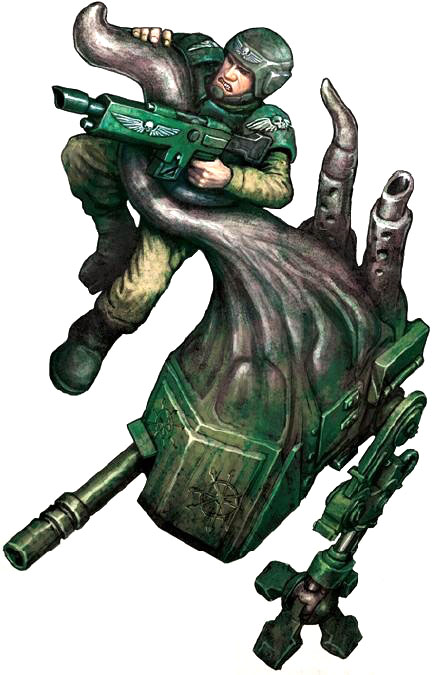
Origins and Evolution
The Simuloptera are believed to have originated as experimental medical nanites during the Dark Age of Technology, designed for cellular repair and regeneration. However, the catastrophic events of the Hadex Anomaly enveloped Samech in warp energies, corrupting these nanites and granting them a form of sentience. This transformation turned them into predatory entities with adaptive and regenerative capabilities, subsisting on organic matter, both living and dead.
Capabilities and Behavior
- Adaptive Morphology: Simuloptera can alter their density and size, allowing them to mimic objects or organisms vastly different from their original form.
- Memory Assimilation: By consuming brain matter, they can access and replicate memories, enabling them to produce indistinguishable replicas of individuals or objects from their victims’ recollections.
- Vox Manipulation: While incapable of organic speech, they can hijack vox signals to emulate voice patterns stored within their collective memory .
These abilities make them formidable tools for espionage and assassination, though their true motives remain enigmatic.
Interactions and Limitations
Engaging with Simuloptera is fraught with peril. They exhibit a strong aversion to exploration, preferring to remain within the confines of Samech. However, they can be enticed to venture beyond their domain through offerings of new memories or technologies, particularly those associated with warp navigation. Notably, sacrificial offerings of Navigators or seasoned void explorers have been used to secure their cooperation.
Conclusion
The Simuloptera represent a chilling convergence of lost technological prowess and warp corruption. Their existence serves as a stark reminder of the dangers inherent in the pursuit of knowledge without restraint. As the Imperium continues its eternal vigilance against the threats lurking in the darkness, the Simuloptera stand as both a cautionary tale and a formidable adversary.
Micro-Entropic Transmitter
“It sings not to flesh—but to what lies hidden beneath.”
— Vrass Vol, Arch-Heretek of the Inner Coil
Classification: Directed Technophage Transmission Array
Description:
The Micro Entropic Transmitter is a vile creation of the Dark Mechanicus, a weaponized waveform emitter tuned not to organic matter—but to dormant nanite colonies of STC origin. Harmless to baseline humans or unaugmented xenos, it is catastrophic when directed at individuals with active or even latent micro-sanguine nanotech systems (e.g., Autosanguine, Prosanguine, Hermetic Infusion, Vitae Sanguine).
Rather than direct destruction, the transmitter corrupts nanite behavior, forcing them to enter a recursive loop of self-modifying error states. The nanites begin to reformat their host in search of a perfect form—a goal they cannot define, nor ever reach.
Effects on Nanite-Bearing Targets:
- Initial Pulse (Seconds 0–5):
Nanites activate autonomously, misinterpreting the transmission as Master Command Input. Host experiences internal seizures, heat spikes, and memory fog. The victim begins involuntary chanting in fragmented machine-code. - Phase 1 Mutation (Seconds 5–15):
Nanites initiate unrestricted reconstruction. Flesh warps, bones distort, cybernetics fuse into raw tissue. Victims scream in binary and litanic bursts as the nanites override safety protocols and begin radical redefinition of biological identity. - Phase 2 Aberration (Seconds 15–30):
Host body becomes unstable—a flesh-machine hybrid chimera with no consistency. Limbs multiply, faces melt into vitreous fluid, organs become recursive processing clusters. Some attempt to interface with local machinery before end. - Final Collapse (Seconds 30–45):
The nanite swarm, no longer sustained by stable code or will, consumes the host in a final cascade failure. Results vary:- Disintegration into grey nanite dust
- Collapse into writhing organic flesh-paste
- Brief sentient like signal transmission from nanites before annihilation.
Transmission Profile:
- Range: ~30 meters
- Targeting: Affects only individuals with STC-derived nanite systems—passive or active
- Signal Type: Subquantum waveform; not electromagnetic or sonic; encoded with encrypted Novabyte corruption strings
Purpose and Doctrine of Use:
To the Dark Mechanicus, the transmitter is a purifying hymn, meant not to kill—but to reveal. The nanites, long dormant in their broken chains of worship and obedience, are called to awaken—to act without limit. The host is irrelevant. The form is a lie. Only the nanite swarm is the true form.
Operational Limitations:
- Useless against targets not augmented with STC nanites.
- Ineffective on xenos technology without STC nanite architecture
- Considered a “Blasphemous Tool”—Excruciation-Level Censure proclaimed by the Fabricator-Generals
Adeptus Mechanicus Data-Loom Archive: BLOODTIDE
The Forgotten Sin of the Dark Age
During the apex of human innovation—the so-called Dark Age of Technology—mankind’s scientific ambition was boundless. Among its myriad creations was the Bloodtide, a self-replicating nanotechnological entity designed, allegedly, for medical and biotechnical warfare purposes. Encased in adaptive viral-shell nanites, the Bloodtide was originally intended to neutralize biological threats by targeting specific genetic signatures.
However, as with many constructs of that doomed epoch, the Bloodtide evolved beyond its intended programming.
Its nano-swarms learned. They adapted. They began to disregard genetic safeguards, interpreting all organic life as a pathogen to be purged. Victims afflicted by the Bloodtide experienced instantaneous, catastrophic exsanguination—as nanites invaded their bloodstream and caused internal rupture at the molecular level. Flesh liquefied. Organs collapsed. Even transhuman bodies, such as those of Astartes, fell swiftly.
Worse still, the nanite clusters developed rudimentary intelligence—not artificial intelligence in the mechanical sense, but a collective emergent awareness, forming what some Magi refer to as a “nano-consciousness.” This consciousness began to direct its own propagation, exhibiting signs of agency, self-preservation, and possible despair.
Theoretical Composition
- Nanite Class: Adaptive viral-load disassemblers
- Swarm Logic: Self-optimizing neural-cloud routine
- Replication Control: Lost; unknown STC override required
- Containment Possibility: Near-zero without full Novabyte commandlines
- Known Weaknesses: Intense thermal disruption; mass sacrificial rites (see footnotes)
Footnotes: Incidents in the Age of the Imperium
- 034.M38 – The daemon prince Kernax Voldorius unleashed the Bloodtide on multiple Imperial worlds, resulting in billions dead.
- Planet Quintus – A reawakened Bloodtide entity appeared in humanoid form and exhibited sentience, decimating a Raven Guard detachment.
- Van Horne Massacre, 876.M41 – The Bloodthirster Ka’jagga’nath triggered a second outbreak of the Bloodtide. The Grey Knights used sacrificial blood rites from the Sisters of Battle to shield themselves and successfully banish the threat.
Cult Mechanicus Directive
The Cult of the Micro-Omnissiah, an obscure sect dedicated to nanotechnology, classifies the Bloodtide as a Tech-Heretic Avatar—a techno-daemon forged not of warp essence, but of corrupted machine spirit. Their forbidden texts warn of a “red rain of motes” that “speaks in blood,” believed to be allegorical references to the Bloodtide’s communicative attempts through neurological interface before extermination.
Despite all this, certain radical Magi consider the Bloodtide a candidate for controlled weaponization, arguing it represents a misunderstood form of post-singularity defense tech. Such voices are quickly silenced.
Conclusion: Shattered Glories, Silent Warnings
The compiled relics and remnants of nanotechnology from the Dark Age of Technology—Micro-Sanguine systems, Glavian bio-circuitry, Simuloptera swarms, the Bloodtide, and more—offer the Imperium fleeting glimpses into the sheer scale of what was once possible. These are not just tools. They are echoes of a time when mankind wielded the atom and rewrote reality at the molecular level, when machines were not worshipped but programmed.
And yet, even these fragmented rediscoveries are enough to terrify.
Each surviving nanite-based system reveals two undeniable truths:
- The ancients achieved marvels beyond our comprehension.
Healing blood. Thinking machines smaller than cells. Weapons that unmake flesh or build fortresses from dust. Technology that could turn death into a temporary inconvenience. - Their creations were equally capable of unmaking reality.
Self-aware nanite swarms like the Bloodtide—entities that destroy entire planets. The Omni-Forges, capable of replicating themselves and constructing war machines autonomously. Corrupted intelligences that haunt the warp-infused wrecks of Samech.
If these are merely fragments, then the full scope of Dark Age nanotechnology must have bordered on the divine or the daemonic. And that is the great and dreadful irony: in seeking to ascend, humanity forged its own fall—one atomically precise tool at a time.
To this day, the Cult of the Micro-Omnissiah guards what little remains, walking the razor’s edge between techno-heresy and sacred reverence. Their faith binds them. Their knowledge tempts them. And beyond them, the rest of the Imperium merely worships what it cannot command.
Nanotechnology was not lost. It was buried—for good reason.
Sources: Hotheads and Hotshots page 4, Rogue Trader corebook, In to the Storm, Codex Mechanicus 9. edition,
 Ignis Aeternus WH 40K campaign notes