
Some of the adventures connected to our current campaign were originally played in the late 1990s, and the Warhammer 40K canon has evolved significantly since then. To stay true to the narrative paths we established in those earlier games, I’ve taken some alternative approaches to canon, particularly regarding the Jokaero.
Our original adventure—and this reinterpretation—was inspired in part by David Brin’s Startide Rising.
While there are many fan theories suggesting that the Old Ones uplifted orangutans into what would become the Jokaero, it’s worth noting that the War in Heaven, which saw the destruction of the Old Ones, ended around 58 million years ago. At that point in Earth’s history, the most evolved primate ancestors were small, tree-dwelling mammals, more similar to rodents than modern apes.
Later canon sources do claim that the Jokaero were created by the Old Ones and do not have connection to life forms on Earth, but I personally find it more compelling—and faithful to our earlier campaign adaptations—to explore a different origin.
!FLUFF warning!
The Inheritors of Terra: The Lost Kin of Mankind
During the Dark Age of Technology, humanity’s scientific prowess reached heights unmatched before or since. In that golden-yet-cursed age, non-human species were uplifted—granted sapience, language, and technological agency by human scientists who fancied themselves gods. These were several primate species and dolphins—each chosen for their usefulness, intelligence, social complexity, and potential for partnership.
The Uplifted Primates – Jokaero Ascendant
It was a coalition of visionary scientists—all of uplifted primate origin—who laid the genetic foundation for what would one day become the species known as the Jokaero. These scientists, operating during the latter centuries of the Early Expansion Era, undertook a radical experiment in directed evolution. By carefully combining genetic traits from across the primate lineage—including humans, orangutans, bonobos, chimpanzees, and extinct offshoots—they engineered a lineage capable of accelerated cognitive development, enhanced manual dexterity, and instinctive technogenic behavior.
At the center of this ambitious project stood Dr. Cornelius Bakunin, a brilliant post-uplift chimpanzee physicist and the first non-human recipient of the Nobel Prize. A fiery advocate for post-uplift rights and ape superiority, Bakunin championed the belief that non-human sentience deserved their own agency in the shaping of the galaxy. His movement, known as Neo-Panthropism, rejected the human-centric vision of the expanding Terran hegemony, proposing instead a primate utopia where uplifted primates could chart their own destinies.
It was theorized by Dr. Cornelius Bakunin himself—the founder of Neo-Panthropism—that uplifted primate species, once liberated from human-imposed constraints, would naturally seek autonomy in both spirit and space. Bakunin proposed that any truly self-aware species must, eventually, choose its own evolutionary and cultural trajectory, free from the shadow of its creators.
His vision of a haven-world for primate descendants, governed not by hierarchy but by instinctual cooperation and technogenic harmony, became a central theme in his later writings. This vision served as a guiding philosophy for the early Jokaero, especially as they began to distance themselves from human civilization.
Though initially integrated into humanity’s expansion during the pre-Dark Age of Technology, the Jokaero ultimately chose to sever ties with human civilization. Their departure occurred during The Great Exodus, the early stages of the Golden Age of Technology, before the rise of the famed Men of Gold—the first fully sentient human-built artificial intelligences.
To the proto-Jokaero, humanity’s growing dependence on synthetic minds and techno-dominion over other species stood in stark opposition to Bakunin’s vision of egalitarian coexistence. Disillusioned by mankind’s path, and perhaps becoming aware of the looming catastrophe that would become the Age of Strife, the Jokaero withdrew entirely from human space. They vanished into the outer void, becoming a nomadic and self-reliant species, defined not by their past or genes, but by an almost mystical instinct for engineering and survival.
During the Age of Strife—that cataclysmic epoch when Terra’s galactic dominion shattered under the weight of Warp storms, techno-barbarism, and the collapse of interstellar communication—many civilizations fell into ruin, their histories scattered like ash across dead worlds.
Amid this chaos, certain ruins bore silent witnesses: field operatives of the Jokaero, traveling alone or in small bands, navigating the debris of fallen archives, derelict datavaults, and forgotten orbital nodes. Unlike scavengers or salvagers, these figures had a singular purpose—not to collect and preserve—but to delete all knowledge about their past and existence from ancient databases.
Acting with clinical precision, they sought out and purged all known records concerning their origins, biogenetic lineage, and any connection to Terra or humanity. Information once held in machine intelligences, genetic logs, or cultural databases was quietly, methodically erased. What could not be deleted was reduced to slag by advanced energy tools or deconstructed at the molecular level.
This act—later referred as the Erasure Protocols—was not a campaign of malice, but one of severance. It marked a deliberate and final ideological break from their creators and captors. No longer would the Jokaero be traced, categorized, or claimed as an offshoot of human ambition.
Even now, Jokaero will react with violent cunning to any attempt to uncover their origin. Their field agents infiltrate, as savant servants, to the Inquisition and among Rogue Traders and quietly observe and keep their race updated on the goals and plans of the Imperium. Across time, they have destroyed archives, assassinated Inquisitors, and sabotaged Mechanicus expeditions that dared probe too deeply into their nature.
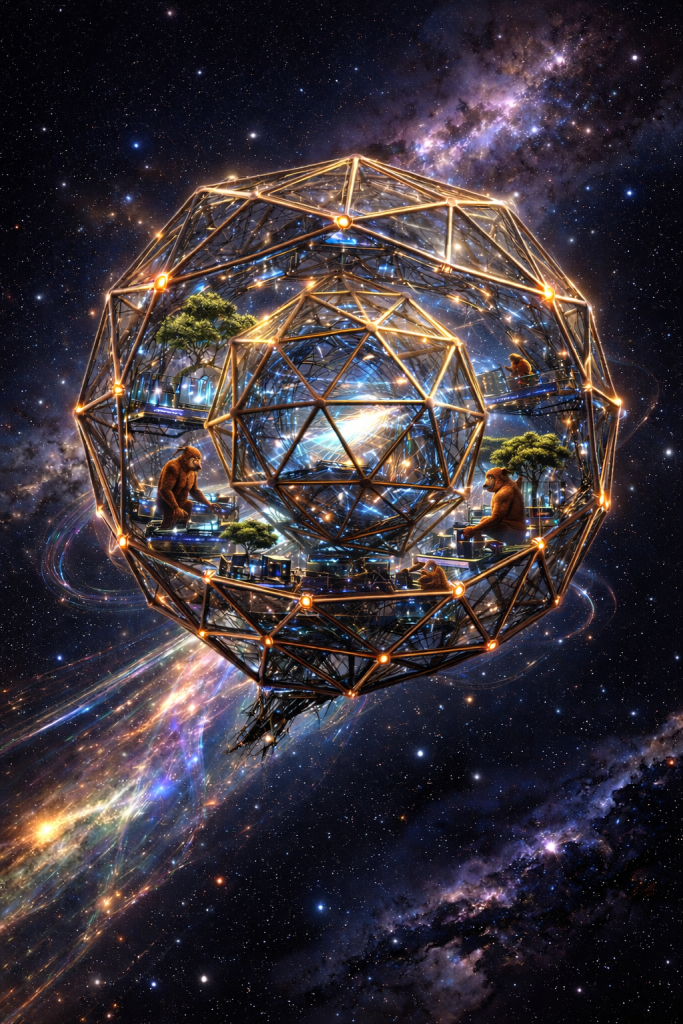
Jokaero Star Vessels and Void Travel
The Jokaero possess an unusually profound understanding of astrophysics, allowing them to perceive and harness unseen power-currents that flow throughout the galaxy—forces unknown to all other starfaring species. Their star vessels are constructed as open, polyhedral lattice structures rather than enclosed hulls, a form unique among void-capable craft encountered by Mankind.
This open architecture is essential to Jokaero void travel. The vessel’s spiralling framework channels these hidden stellar currents in a manner analogous to the way Force Weapons conduct psychic energy. By continuously altering their ship’s physical geometry—subtly reshaping angles, spirals, and resonant nodes—Jokaero vessels can generate thrust, manoeuvre, and even transition into the Warp without reliance on conventional engines or drives.
Equally vital to this design is the Jokaero mastery of forcefield technology. Rather than enclosing their vessels within armoured hulls, Jokaero starships project layered, interlocking energy fields that provide containment, environmental stability, and protection against the hard vacuum of space. These fields also serve as the vessel’s primary defence in void combat, dispersing kinetic impacts, thermal energy, and directed weapons fire without the need for physical armour or solid walls.
To Imperial observers, Jokaero craft appear less like ships and more like living mathematical constructs—self-adjusting frameworks of geometry and energy, navigating the void through resonance and form rather than mass and metallurgy.
Jokaero Language and the Mask of Silence
Although Imperial sources commonly assert that the Jokaero possess no true language—communicating only through gestures and instinct—this belief appears to be a deliberate misconception cultivated by the Jokaero themselves.
Evidence suggests that among their own kind, the Jokaero employ a structured and highly precise vocabulary, likely multimodal in nature and intertwined with tonal patterns, spatial geometry, and technological interaction. This internal language is never displayed in the presence of outsiders. Any human who demonstrates awareness of Jokaero linguistic capability is said to vanish shortly thereafter, their disappearance leaving no reliable trace or official record.
An anomaly supporting this interpretation appears in Codex: Necrons (3rd Edition), which states that the Jokaero possess knowledge of the C’tan known to the Imperium as the Deceiver, referring to it by the name Artemorra. Whether this reference represents an error, a ret-con, or an accidental disclosure is unknown. It is equally plausible that it constitutes a rare glimpse behind the carefully maintained Jokaero façade.
Imperial xenologists remain divided on the matter. Some argue that the Jokaero’s apparent silence is genuine, while others suspect it is a conscious strategy—one that allows them to observe, manipulate, and endure within the Imperium while remaining underestimated. If so, the greatest Jokaero invention may not be their technology, but the illusion of harmless incomprehension
The Jokaero Doctrine
The Jokaero now view the truth of their origin as a dangerous secret. They believe that if humanity remembered what it did to its fellow Terran children, it would unravel—or worse, repeat its sins. Thus, they act. Silently. Systematically. With tools of absurd genius.
The Dolphins – Silent Beneath the Void
Their cousins in the deep—the uplifted dolphins—took a very different path from the Jokaero. Though similarly enhanced during the Dark Age of Technology, the dolphins chose isolation and evasion over integration or rebellion. Most records of their civilizations were lost in the ravages of Old Night, or erased during the Erasure Protocols—deliberate data purges carried out by Jokaero operatives.
Still, clues have surfaced: fragmentary transmissions of sonar code, and a derelict voidcraft adrift near dead oceanic worlds. A silent vessel containing bioluminescent script, sealed aquatic quarters fitted with Standard Template Construct (STC) components, and genetic signatures unmistakably linked to Earth’s marine biosphere.
Origins in War
The first uplifted dolphins were not explorers or philosophers—they were weapons. Engineered during the later stages of the Early Expansion Era, these marine mammals were part of a military experiment intended to produce superior fighter pilots for the Terran starfleet. Their neural architecture, social pack-bonding, and 360-degree echolocation made them ideal candidates for non-human piloting roles in complex combat environments.
To increase their aggression and combat effectiveness, their genome was partially spliced with that of orcas, enhancing their capacity for violence and territorial dominance. The result: swift, brutal, and instinct-driven pilots whose minds were as sharp as their sonar.
Bloodlines and Redemption
Over the millennia, the now-independent dolphin civilizations—operating in self-governed ocean arks—have attempted to purify their bloodline, distancing themselves from their war-born origins. Yet, the orca legacy remains. Even today, individuals still emerge who are drawn to violence—those who, as the dolphin idiom goes, “love the smell of blood on the morning tide.”
Such individuals are considered a threat to the greater whole and are banished from the Arks, and left behind on desolate ocean worlds.
Silent Nomads
Like the proto-Jokaero and the ancestors of the Leagues of Votann, the dolphin enclaves are believed to have fled the Sol System at the dawn of the Age of Strife, taking to the stars in vast, water-filled ocean arks. These ships travel fast and deliberately, hiding within nebulae, comet clouds, and empty void, orbiting planets only when absolutely necessary.
Every few thousand years, an Ocean Ark must replenish its liquid reserves, collecting fresh water and harvesting supplies from oceanic exoplanets, icy moons, or dense comet fields. These rare planetary visits, if ever witnessed, become the stuff of myth—recorded in the legends of fringe worlds, or mistaken for the passing of ancient gods.
The Dolphin Stance
The dolphins, for all their silence, may be preparing. Some evidence suggests the construction of land-based exosuits designed not for offense—but defense. As if expecting a war, they once swore to avoid.
Addendum: The Cetacean Legacy — A Potential Threat
It is an often-overlooked truth within restricted Ordo Geneticae records that dolphin neural alleles—heavily modified and post-uplift—form the scaffolding for vast regions of Navigator brain architecture. Their legacy lives not in the flesh, but in the synaptic instincts and sensory harmonics that guide Warp navigation.
Should the Ocean Arks of the post-human Cetacean enclaves—silent and sovereign since the Age of Strife—ever come to understand the full extent of this genetic inappropriation, the implications could be dire.
To this uplifted aquatic species, long committed to isolation and autonomy, the Navigator strain would not be seen as kin, but as a blasphemy: gene-raped cousins, engineered against the consent of their ancestral line and bound in human flesh and eternal servitude to the Imperium of Man. The Imperium, already blind to a thousand gathering threats, may one day face the wrath of a civilization beneath the void, if this ancestral crime is ever brought to light.
Amphibious Combat Dolphin with Exosuit
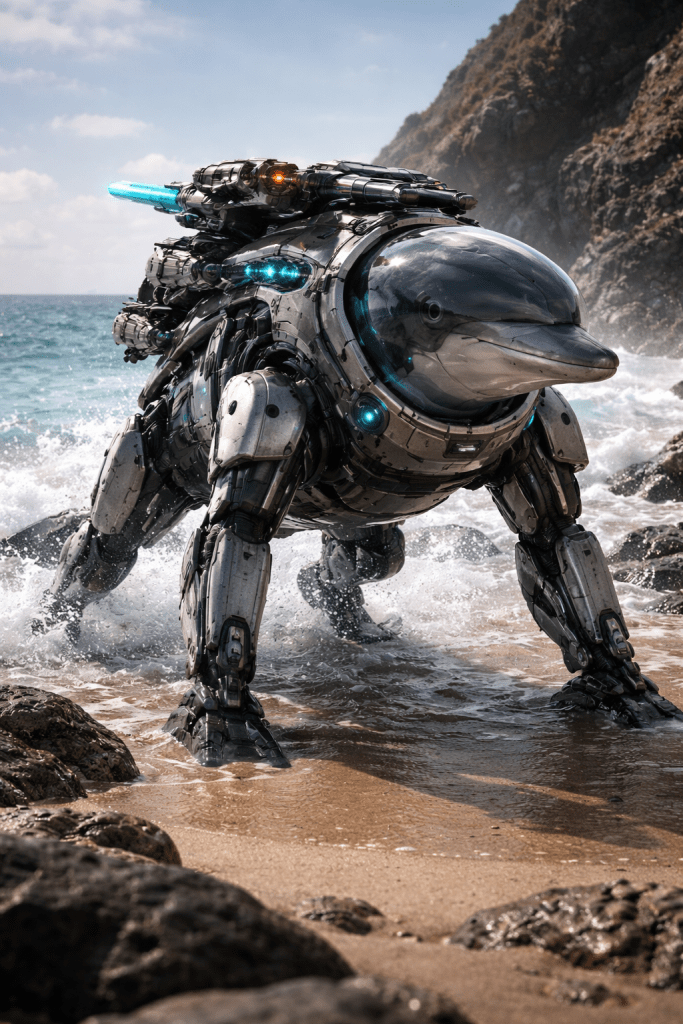
Exoskeleton Design
- Form: A four-legged, articulated exosuit made of lightweight ceramite and plasteel alloys. Legs mimic digitigrade structure for balance, with webbed pressure-sensitive feet for aquatic propulsion and grippy pads for rocky terrain.
- Harness Structure: The dolphin’s body is cradled horizontally in a suspension harness filled with nutrient gel and equipped with life-support systems to keep its skin moist and temperature-regulated during land deployment.
- Motion Systems: Hydraulic limbs are controlled via neural interface directly from the dolphin’s brain, translating sonar and bio-impulse cues into mechanical movement. Tail fins can tuck beneath the chassis.
Weaponry
- Mounted Plasma Cannon: A dorsal-mounted, medium-yield plasma projector capable of short-burst high-energy shots. It vents heat laterally through the rear vents of the exosuit. Requires charge cycles between volleys.
- Secondary Armaments: Potential for undercarriage-mounted flechette or shock-net launchers for non-lethal suppression.
- Micro-missile launcher: 12 independently guided krak missiles.
Cognitive Interface
- Neuro-AI Link: The dolphin communicates with others via an implanted vocal modulator or pictographic display. Can also operate semi-autonomously using tactical AI overlays and sonar-mapped battlefield data.
- Sensory Enhancements: Sonar integrated into the exosuit is enhanced by thermal and infrared visual systems for navigation and targeting in non-aquatic environments.
Operational Environments
- Water: In water, the legs fold back, and the exosuit propels using thrusters and mimicing the dolphin’s natural movement.
- Land: Once on land, the limbs extend and lock into place. Capable of moderate speed movement over uneven ground, with stability-assist gyros managing terrain shifts.
 Ignis Aeternus WH 40K campaign notes