

Dr. Kirsten Maywood
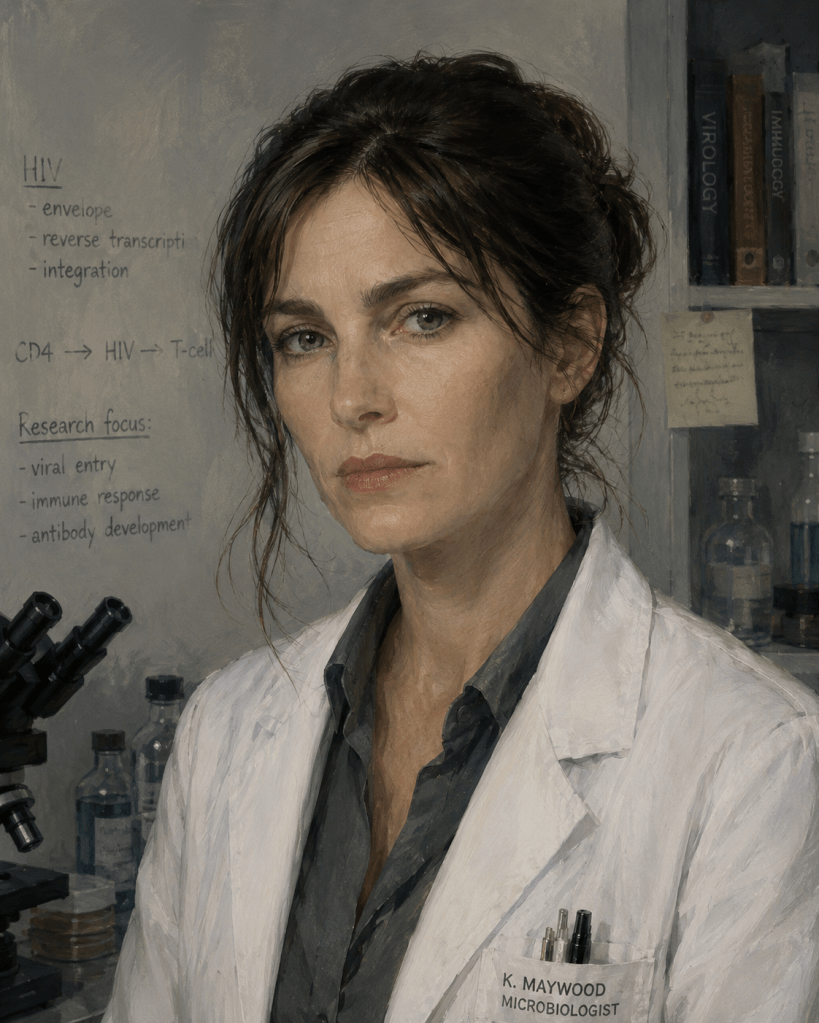
Dr. Kirsten Maywood is one of the country’s leading microbiologists and infectious disease specialists. In her early forties, she possesses a striking but understated beauty: dark hair usually tied back, intelligent grey eyes, and a calm, focused demeanor. Her appearance is immaculate but practical, more concerned with competence than fashion.
The AIDS crisis shaped her life. Her older brother was among the first victims during the panic and uncertainty of the epidemic. Watching him die while doctors stood helpless convinced her to dedicate her life to infectious disease research. Decade later she has become an internationally respected expert, but the work has consumed much of her personal life. Few people can engage her intellectually, and fewer still understand the loneliness that comes with spending years searching for cures that never seem to come.
First Meeting
Kirsten opens the examination room door and offers a professional smile.
“Mr. Dumiroir? Please come in.”
“Have a seat. I understand you’re here for HIV screening. Before we begin, I need to ask you a few routine questions regarding your health and sexual history. Everything discussed here is strictly confidential.”
“Over the past several years, approximately how many sexual partners have you had?”
“Do you know if any of your partners were HIV positive, intravenous drug users, or involved in other high-risk activities?”
“Have you experienced any unusual illnesses, persistent fevers, unexplained weight loss, night sweats, or recurrent infections?”
“I know some of these questions can be uncomfortable, but accurate information helps us interpret the test results correctly.”
After completing the interview she prepares the syringe.
“Good. Just a small blood sample.”
“The laboratory usually handles these cases, but I’d like to review your results personally. I’ll contact you as soon as the analysis is complete.”
The Discovery
At first, Dr. Maywood assumes there has been a mistake.
Thomas Dumiroir’s blood sample arrives as part of a routine HIV screening. Nothing about the patient interview seems remarkable. The first anomaly appears when standard laboratory cultures begin to fail.
Pathogens exposed to Thomas’s serum rapidly degrade or die. Viruses lose viability, bacterial cultures fail to reproduce, and fungal samples collapse. Assuming contamination or equipment failure, Kirsten repeats the tests several times using fresh reagents. The results remain unchanged.
The deeper she investigates, the stranger the blood becomes. Its immune markers do not match any known condition, and the serum appears capable of rapidly adapting to and neutralizing new pathogens. It is as though the blood learns.
Even more remarkable, Thomas appears perfectly healthy. There is no inflammation, autoimmune activity, or cellular damage. By every conventional model, such a system should be impossible.
At first Kirsten is excited.
The death of her brother during the early AIDS epidemic shaped her entire career. She has spent years searching for better treatments and, ultimately, a cure. Now she believes she may be looking at the single greatest medical discovery of her lifetime.
Her interest in Thomas is not personal. He is a patient and, potentially, the key to understanding a biological mechanism capable of eliminating HIV and perhaps countless other infectious diseases. If the process can be understood, replicated, or synthesized, millions of lives could be saved.
This conviction becomes increasingly difficult to resist.
Every additional test raises new questions. Every answer suggests that Thomas possesses a biological property unlike anything documented by modern medicine. Kirsten begins bending protocols, then quietly bypassing them. She delays sharing results with colleagues, partly because she fears ridicule, and partly because she is afraid someone else will take control of the research before she understands it.
What begins as scientific curiosity gradually becomes fixation. Not because she seeks power, wealth, or fame, but because she becomes convinced that the answers hidden within Thomas’s blood could end enormous amounts of human suffering.
That belief allows her to justify almost anything.
The Phone Call
Kirsten contacts Thomas personally.
Her tone is professional but unusually attentive.
“Mr. Dumiroir? This is Dr. Kirsten Maywood.”
“I apologize for contacting you so late.”
“There is absolutely no cause for alarm. Your results were… unusual. Not immediately dangerous. Merely unusual.”
“I’d like to perform a few additional tests to verify some laboratory findings.”
“You can come to the hospital if that is convenient. If not, I can visit your residence personally.”
“The sooner we repeat the tests, the sooner I can give you more definitive answers.”
The important detail is that she is far more eager than a doctor normally would be.
A perceptive character may notice that she is trying very hard to sound calm.
The Meeting
Kirsten arrives with equipment prepared for blood collection.
She appears unusually concerned about Thomas’s comfort and well-being.
She asks questions about:
- his health,
- his family history,
- childhood illnesses,
- injuries,
- medications,
- unusual experiences.
Many of the questions seem only loosely connected to infectious disease.
She pays close attention to every answer.
The GM may choose to add subtle tension, admiration, curiosity, or emotional intensity to the conversation. Nothing overtly romantic is required; the key element is that Kirsten is becoming fascinated by Thomas as a scientific mystery.
Sedation
At the beginning of a meeting Kirsten offers Thomas a drink, claiming that proper hydration will improve sample quality and reduce discomfort.
Unknown to Thomas, she has decided to collect far more data than he consented to provide.
By now she crosses an ethical boundary she cannot uncross as she convinces herself it is necessary.
As Thomas loses consciousness, Kirsten proceeds with a series of unauthorized examinations and sample collection procedures intended to uncover the source of his extraordinary biology.
Awakening of Thomas
Consciousness returns in fragments.
At first there is only sound.
A slow, rhythmic clicking.
Metal striking metal.
A faint hiss.
For several seconds you cannot remember where you are.
Your body feels impossibly heavy. Your arms and legs seem distant, as though they belong to somebody else. The numbness in your mind recedes with unnatural speed, leaving only a dull pressure behind your eyes.
You blink.
The lights above you slowly sharpen from a white blur into distinct circles.
Something moves nearby.
You turn your head.
A machine sits on a table beside you.
It looks as though it belongs in a museum rather than a hospital.
The device is housed inside an old physician’s leather case. Its frame is polished oak and brass, the corners stained green by decades of oxidation. A hand crank, which Dr. Maywood is enthusiastically turning, protrudes from the lid. As it turns, an internal dynamo produces a low electrical hum that blends with the steady ticking of the mechanism.
Two cloth-covered wires emerge from the case. At their ends are black rubber electrodes fitted with worn leather straps. They are both connected to your naked groin.
The opposite half of the case contains a small vacuum pump and a tube inserted to your urethra. Its piston moves with slow mechanical precision, advancing and retreating in perfect rhythm with the turning crank. Brass fittings click softly with each stroke.
A pressure gauge trembles.
A glass collection vessel reflects the harsh electric light overhead.
The entire apparatus looks absurdly old.
Yet it is clearly operating.
The rhythmic ticking fills the room.
Your gaze settles on a tarnished brass plate riveted to the side of the case.
The inscription reads: MODELL VII – APPARAT FÜR NEUROLOGISCHE UNTERSUCHUNG UND STIMULATION, ZÜRICH, 1912
You feel the electrical current starting to twist you from inside. What do you do?
Purpose of the Encounter
These scenes serve three important narrative functions.
1. Reveal the Gaps in Thomas’s Past
During the interview and subsequent conversations, Dr. Kirsten Maywood (and the player of Thomas) gradually discovers that Thomas possesses only fragmentary memories of his life before the last few years.
He can describe recent events, relationships, and experiences in reasonable detail. However, any attempt to discuss his earlier life produces confusion, contradictions, missing years, or a complete absence of memory.
Kirsten initially interprets this as a psychological condition, trauma response, substance abuse, or dissociative disorder.
The players should leave the scene realizing that something is deeply wrong with Thomas’s personal history.
2. Establish Thomas’s Self-Destructive Lifestyle
Kirsten’s questioning reveals a pattern of reckless behavior.
Thomas frequently engages in dangerous sexual encounters with strangers.
He regularly abuses drugs and alcohol.
Most notably, he consumes absinthe to excess and often experiences blackouts, waking with little or no recollection of what occurred.
The scene should leave open the question of whether these behaviors are merely self-destructive habits or symptoms of a deeper supernatural influence.
3. Reveal the Mystery of Thomas’s Blood
The central revelation of the encounter is that Thomas’s blood is biologically impossible.
Kirsten discovers that pathogens exposed to his blood rapidly die or lose viability. The effect cannot be explained by any known medical process.
To Kirsten, Thomas represents the possibility of curing HIV and perhaps countless other diseases. Her interest in him is genuine but primarily scientific and humanitarian.
The players should understand that Thomas is not merely unusual.
Something inside him violates the ordinary laws of biology.
Kirsten does not yet know what that something is.
Neither does Thomas.
But both leave the encounter aware that his blood may hold a secret worth killing for.
Handouts:
MAYWOOD INFECTIOUS DISEASE RESEARCH UNIT
ST. BARTHOLOMEW MEDICAL CENTER
CONFIDENTIAL PATIENT FILE
Attending Physician: Dr. Kirsten Maywood, MD, PhD Department of Infectious Diseases and Microbiology
Patient Name: Thomas Dumiroir Date of Examination: [GM Insert Date]
Reason for Visit
Patient requested HIV screening following concerns regarding prior sexual activity and possible exposure to bloodborne pathogens.
Initial Interview Summary
Patient presents as physically healthy and cooperative.
Notable findings from interview:
- Extensive history of unprotected sexual encounters with numerous partners.
- Frequent use of recreational drugs and alcohol.
- Reports repeated episodes of memory loss associated with absinthe consumption.
- Patient demonstrates unusually limited recollection of personal history extending beyond the last several years.
- Childhood history, family history, and significant portions of early adulthood remain unclear or inaccessible to the patient.
- Patient appears unaware of these memory deficits and is unable to explain them.
Recommendation: Neurological and psychiatric evaluation may be warranted.
Physical Examination
General health excellent.
No signs of:
- Chronic infection
- Immunodeficiency
- Neurological degeneration
- Organ dysfunction
Patient appears significantly healthier than expected given reported lifestyle factors.
Laboratory Findings
Initial HIV screening: NEGATIVE
Additional screening:
- Hepatitis A/B/C: NEGATIVE
- Syphilis: NEGATIVE
- Tuberculosis markers: NEGATIVE
No identifiable viral, bacterial, fungal, or parasitic infection detected.
Results considered highly unusual given patient history.
Research Notes
The following observations are restricted to authorized personnel.
Repeated testing performed to exclude laboratory error.
Patient serum demonstrates unprecedented antimicrobial activity.
Observed effects include:
- Rapid reduction in viral viability.
- Inhibition of bacterial reproduction.
- Collapse of fungal cultures.
- Unexpected activity against organisms normally resistant to immune response.
Results reproduced across multiple samples.
Current medical literature provides no satisfactory explanation.
Personal Notes — Dr. Maywood
The patient represents a unique scientific anomaly.
The observed immune response cannot be explained by any known mechanism. Preliminary findings suggest the presence of a previously undocumented biological process capable of identifying and neutralizing pathogenic organisms with extraordinary efficiency.
If these findings can be verified and understood, implications for the treatment of HIV and other infectious diseases may be profound.
Additional samples required.
Further investigation strongly recommended.
FILE STATUS
ACTIVE RESEARCH INTEREST
Access Restricted
Authorization: MAYWOOD-K7

