
System Overview
Planetary Overview

- Classification: Feral World
- Sub-sector: Drusus Marches
- Sector: Calixis Sector
- Segmentum: Obscurus
- Affiliation: Imperium of Man
Endrite is a primitive, untamed world on the frontier of Imperial space—wild, brutal, and only loosely tethered to the Emperor’s light. The planet’s single large continent is covered in ancient jungle, acidic
tar pits, and jagged mountain ranges, but its most iconic landmark is the shattered carcass of an
ancient Imperial Battlecruiser, buried and half-consumed by time.
The Tribes of Endrite
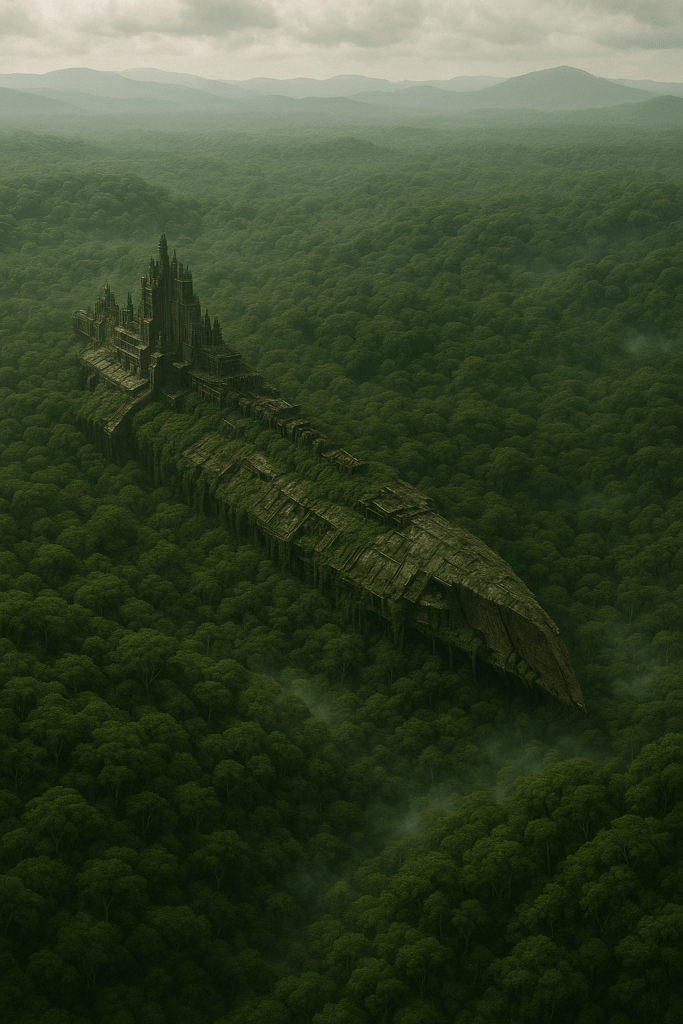
The human population of Endrite descends from the survivors of the Battlecruiser, whose catastrophic atmospheric breach occurred during the early consolidation of the Calixis Expanse. The crash annihilated the ship’s infrastructure and erased all means of communication or off-world rescue.
Over the course of time, the descendants of the survivors devolved into fractured, hostile tribal societies, shaped by isolation, ecological hardship, and the slow decay of remembered Imperial order into superstition.
Cultural Lineages and Tribal Identity
Each extant tribe claims ancestral descent from a distinct shipboard caste—menials, officers, armsmen, or technomats—and derives its social hierarchy, rituals, and even body ornamentation from half-remembered interpretations of those castes’ duties.

member
- Tarborn Tribes – Officer crew origin tribes maintain rigid hierarchies, viewing themselves as divine rulers of the world; their dialects are more elaborate, preserving fragments of High Gothic as ritual language.
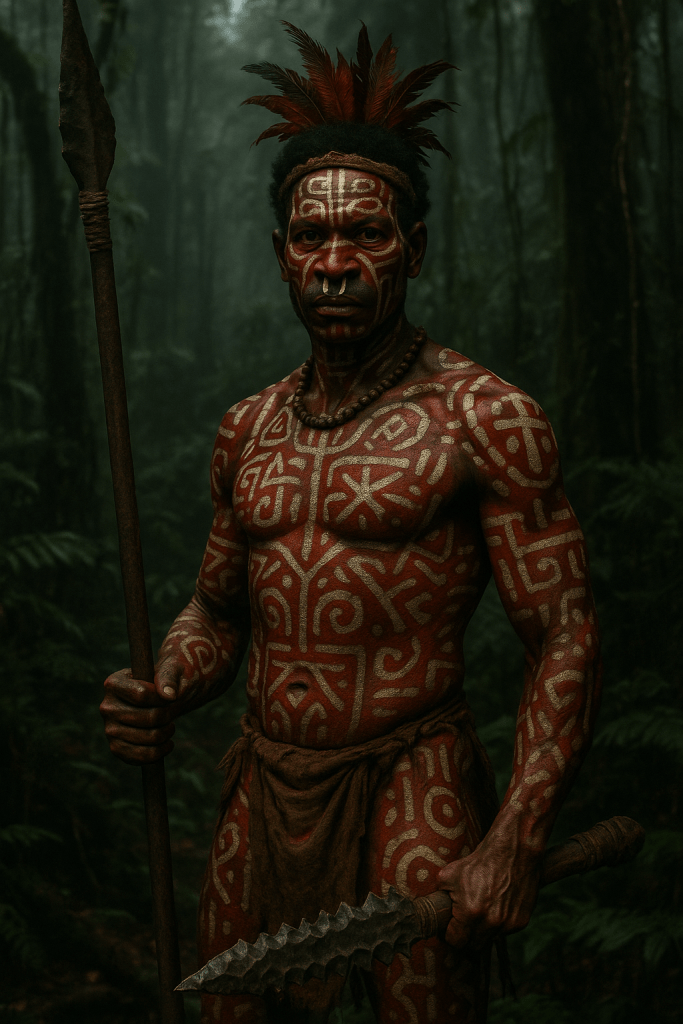
- Ash-Tongue Tribe – Armsmen crew origin tribes dominate the warlike river valleys and scarplands, their culture centered on martial contests and inter-tribal raids.
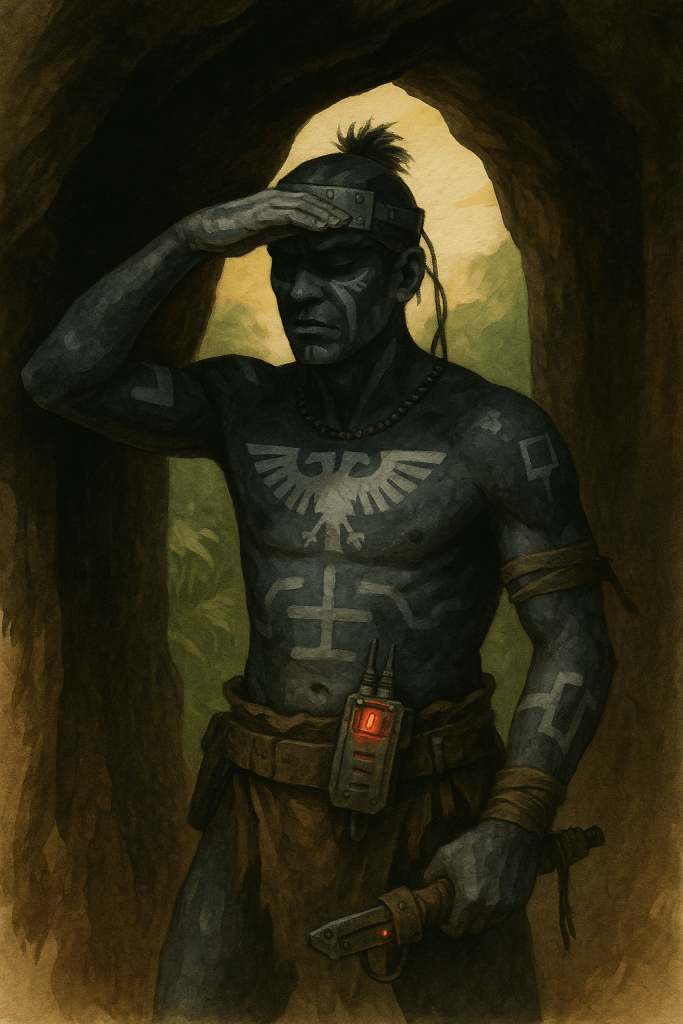
- Cave Tribes – Technomat crew origin tribes are the most secretive, occupying the great caves of the hill ranges. They are seen by others as sorcerers or “machine-eaters,” communing with the rusting spirits of the fallen star.
Each tribe considers all others to be aberrant mutants, unworthy of contact or kinship. Interbreeding is taboo, seen as a pollution of ancestral essence, and is punishable by ritual exile.
Physiology and Genetic Drift
Despite extreme isolation and environmental pressure, the tribes remain within Imperial genetic tolerances for baseline humanity. Distinctions persist primarily in phenotype and conditioning: armsmen tribes exhibit hypertrophic musculature and dense scar tissue from ritualized violence, while technomat tribes show chronic albinism and photosensitivity from life within caves.
State of Technology and Material Culture
Technological regression on Endrite is near total. The tribes exist at a late stone or proto-metallic level—stone axes, bone-tipped spears, and obsidian knives are the tools of daily life.
Yet remnants of the crashed battlecruiser persist as relics of almost religious significance. Fragments of the ancient ship’s technology are hoarded, worshipped, and occasionally used, though few understand their true function.
- Rusted truncheons serve as hereditary war clubs, their dents and pitting recorded as ancestral marks.
- Field shovels double as tools and execution blades.
- Lasgun hilts with snapped bayonets are revered as light-spears—icons of the Emperor’s tools.
- Combat knives and helmet fragments are bound into warrior garb as protective talismans.
Among these relic-keepers, the Technomat tribes stand apart. Whatever knowledge their ancestors once held of circuitry, energy, or function has long since degenerated into ritual and habit. Of the once-great craft of the Mechanicus, only a single practice endures: the ability to coax faint life into the ancient power cells of the Fallen Star.
The method is crude and born of myth. The tribes place the corroded cells into open flame, believing the fire to “feed the sleeping spirit within.” Centuries of this scorching have nearly destroyed the relics, leaving them capable of charging only a single charge to an Imperial device—a brief pulse to ignite a lasgun once, empower a shock baton for a single strike, or awaken a hand-scanner for a momentary glow.
Warfare and Social Order
Violence on Endrite is constant and ritualized, woven into the fabric of tribal life. Raids, ambushes, and duels serve not only as means of resource competition but also as vital expressions of identity and spirituality.
Inspired by patterns observed among primitive Terran analogues—Amazonian river tribes, Papuan highland clans, and Samoan warbands—the warfare of Endrite is characterized by:
- Seasonal conflict cycles, following monsoon and dry periods, when hunting yields decline.
- Skirmish warfare, reliant on ambushes, jungle traps, and massed projectile volleys of bone-tipped darts or spears.
- Vendetta culture, where blood debts between clans are inherited through generations.
- Trophy-taking and corpse rituals, marking prestige and lineage.
- Warrior cults that venerate combat as communion with the Emperor’s consuming light.
Most engagements occur along river valleys and flood basins, where fertile soil and navigable waterways make resources worth killing for. The density of tribes and the constant cycle of vengeance ensure that Endrite has never known peace in recorded memory.
Sociological Notes
Anthropological consensus within the Calixian Ordo Anthropologica regards Endrite’s population as feral-Imperial, a category denoting post-catastrophic regression rather than abhuman divergence. The natives remains viable for Imperial resettlement or Guard conscription if pacified, though cultural reintegration would likely require orbital bombardment followed by total reeducation.
Imperial Symbolism and Worship
The ruined Battlecruiser is at the spiritual center of tribal culture. Though no longer functional, it has become a holy shrine, believed to be a direct link to the God-Emperor.

- Tribes journey across hostile terrain to offer sacrifices, food items, tools and heads, at its shattered hull.
- Common bloodshed is strictly forbidden within its visible range — a sacred demilitarized zone where even sworn enemies lay down their arms. Only sanctioned ritual duels, fought under the gaze of the Imperial aquila, are permitted, their violence bound by custom and faith.
- Periodic Imperial ship visits—for recruitment or archaeological study—are mythologized as the descent of sky-gods, reinforcing the Battlecruiser’s status as a divine monument.

Imperial Exploitation & Recruitment
Though primitive and largely unindustrialized, Endrite has long drawn the covetous eye of Imperial authorities and opportunists alike. Its vast jungles, abundant biomass, and hardy native population make it a tempting prize for both sanctioned and unsanctioned exploitation.
Commercial Interest
The Baraspine Merchant Conglomerate formally registered Endrite under a dormant resource claim nearly three centuries ago, intending to harvest its immense fungal forests for the manufacture of Jungleboard—a low-grade composite used as a cheap replacement for hab-paneling and hive insulation across the sector. The material is strong but unstable, prone to decay and mold infestation within years of installation.
Although the claim remains active in Administratum archives, logistical neglect and the absence of secure landing zones have prevented large-scale exploitation. Sporadic survey and extraction missions occasionally return to strip isolated valleys bare before abandoning operations to rot and overgrowth. These short-lived ventures have left the planet scarred with derelict crawler tracks, crashed haulers, and ghost camps swallowed by vine and fungus.
Beyond sanctioned commerce, Rogue Traders, Imperial Navy resupply crews, and slaver vessels have repeatedly preyed upon the planet’s population. These irregular incursions have become a grim constant of Endrite’s history. Such raids disrupt any attempt at social consolidation, forcing the tribes into migratory patterns and preventing the rise of stable settlements or technological rediscovery.
The people of Endrite have thus remained locked in a cycle of isolation and fear: each generation learns that strangers from the sky bring both desolation and ruin.
Munitorum Recruitment
The Departmento Munitorum classifies Endrite as a Manpower Reservoir World, its population deemed suitable for recruitment under the Feral Headhunter Levy Protocols. Endrite’s warriors, once captured and conditioned, are forged into the notorious Headhunter Regiments—infantry formations infamous for their close-quarters brutality, shock ambushes, and ritualistic use of enemy trophies.
Recruits are transported to off-world training stations where they undergo brutal re-education. Commissars and itinerant Ecclesiarchy chaplains enforce discipline through fear and faith, converting tribal superstition into sanctioned zeal. While many perish during the process, those who survive emerge as fierce soldiers, their savagery turned to Imperial service.
These regiments are often deployed as expendable spearhead troops during urban sieges or boarding actions—scouting the most lethal zones before disciplined Guard elements advance. Their losses are rarely recorded in official archives.
Cultural Consequences
Imperial recruitment drives occur without pattern or mercy. At irregular intervals, great voidships descend to orbit, their holds opening like hungry maws. Entire villages are seized—men, women, and children alike—while orbit-to-surface bombardments erase traces of resistance.
Among the tribes, these events are remembered as “The Hunger of the Sky-God.” Some interpret conscription as divine ascension, believing their kin are taken to be eaten by the Emperor Himself; others see it as a curse, hiding in the deep jungle when the heavens burn red with the fire of descent.
Constant predation by Rogue Traders, slavers, and Guard levies has ensured that Endrite’s society never develops beyond nomadic hunter-gatherer clans. Attempts to build permanent villages or reforge ancient technologies are crushed before they can take root—either by raids or by rival tribes desperate to avoid detection.
Formation & Geobiology of Endrite’s Tar Basins
In Endrite’s equatorial lowlands stretch vast mangrove-moss jungles, where choking humidity and constant rainfall create a perpetual cycle of growth, decay, and burial. Over uncounted millennia, these wetlands have evolved into organic sinks—layer upon layer of decomposing vegetation, fungal colonies, and carcasses compressed into the planet’s saturated crust.
Beneath the living canopy lies a stratified abyss of rot, a hundred metres deep in places, where oxygen cannot penetrate. Within these lightless depths, colonies of chemotrophic bacteria and extremophile archaea consume the dead biomass and transmute it into tar-rich sludge—a substance chemically near-identical to crude prometheum feedstock. Each layer represents an epoch of decay, compacted under the weight of time into black hydrocarbon reservoirs of immense density.
The implications are extremely profitable. If properly surveyed and industrialized, these bacterial tar-beds could yield a sustained promethium output rivaling secondary refinery worlds. Administratum models would predict that full exploitation of even a fraction of Endrite’s lowland basins would increase the planet’s tithe potential a hundredfold, transforming it from a neglected death world into a strategically vital fuel source for the Drusus Marches.
Such a revelation would redraw Imperial interest overnight. What the tribes see as cursed bogs of the dead, the Imperium would see as an untapped ocean of sacred fire—a reservoir of profit, devotion, and power waiting to be claimed in the Emperor’s name.
Fauna & Natural Hazards

- Tusked Swine:
- Tar Pits: Acidic and unstable, these pools are used to preserve corpses.
- Toxic Spores: Wind-borne fungal clouds occasionally sweep across open terrain, leaving tribes temporarily blinded or comatose.
Ecosystem and Population Dynamics
Ecological Origin
Endrite was originally terraformed during the Dark Age of Technology, its biosphere designed for self-regulating equilibrium. The planetary engineers seeded a closed-loop ecosystem of immense biodiversity: vast rainforests layered with photosynthetic canopies, colossal herbivores maintaining ground-level circulation, and apex predators enforcing balance through selective predation.
No evidence of pre-Imperial habitation or surviving technological infrastructure has been identified. By the time the first human survivors of the crashed battlecruiser arrived, Endrite’s ecosystem had already reached a stable, mature state.
Phase I – Arrival and Expansion
The arrival of Imperial humans disrupted this balance. With no natural enemies, abundant fauna, and rich edible flora, the population of the stranded crew and their descendants exploded within only a few centuries.
Large game animals — once the keystones of the ecosystem — were hunted to extinction across regions. Their disappearance removed the grazing and trampling forces that kept undergrowth in check, triggering a silent ecological cascade.
Phase II – Collapse and Cannibal Equilibrium
As the great herbivores vanished, the lower canopy thickened into an almost impassable tangle of green. Hunting within the deep jungle became futile, driving the tribes toward the riverbanks where fresh water still flowed — and where life, however sparse, could still be found.
The extinction of the great grazers also doomed the predators that once hunted them. The roars of Endrite’s apex beasts faded from the jungles, leaving only silence and the restless hum of insects. With the top and bottom of the food chain both collapsed, the ecosystem lost its balance entirely.
Competition for the dwindling resources along the waterways grew savage. With no game left to hunt, humans began preying upon one another, not as part of any ritual or faith, but as acts of desperation. Origin of cannibalism wasn’t ceremonial — it was survival.
Over generations, famine and conflict thinned their numbers, until the population settled into a grim balance with the impoverished ecosystem that remained.
Phase III – Present State
Today, Endrite’s jungles are dominated by dense, stagnant undergrowth. The largest surviving animals are small omnivores resembling tusked swine, hunted with nets and spear traps by the scattered human tribes.
The planet’s biomass remains immense, but its structure has inverted: what was once a balanced trophic pyramid is now a tangled web of decomposers, parasites, and opportunists.
The surviving human population persists at a density sustainable only through constant movement, scavenging, and predation upon one another — the final human apex species of a fallen ecosystem.
Fragmented Faith of the Endrite Tribes
Following centuries of isolation and cultural decay, only fractured echoes of the Imperial Creed survive among the tribes of Endrite. The ancient faith has withered into a collection of half-remembered myths and fearful superstitions.
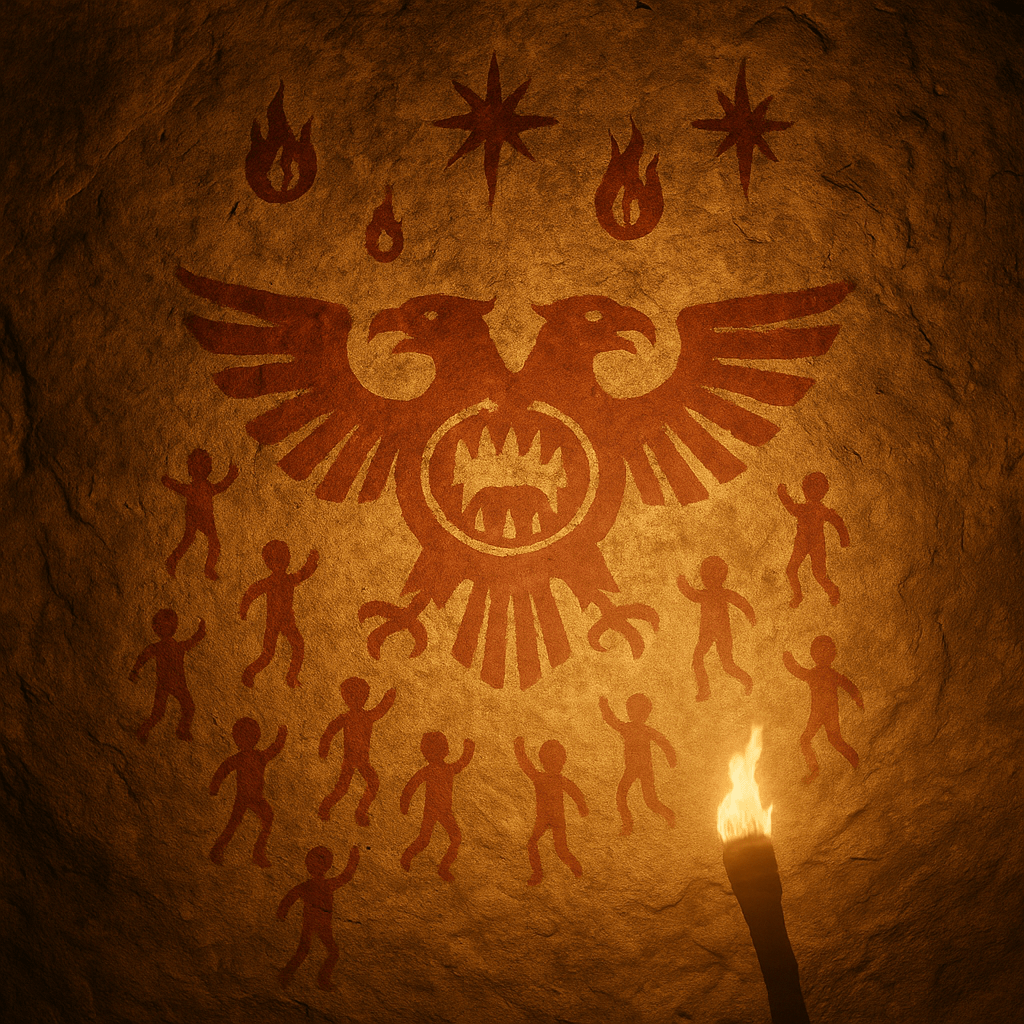
The tribes speak of the Skyfires—flashes of lightning or meteor trails that burn across the heavens and the jungle. These are believed to be the Emperor’s summons, calling souls to ascend into His hungry maw, where the they are devoured.
Death in ordinary circumstances is viewed as meaningless, but to die in battle carries divine promise. Warriors who slay at least three enemies before their own death are said to be reborn through the bloodline—their souls returning when their descendants bear new life. This belief has replaced formal notions of sainthood or salvation, binding honor, violence, and ancestry into a single sacred continuum.
To the tribes, the Emperor is no longer a distant god of light and law, but a cosmic predator—a consuming sun whose hunger ensures the cycle of life continues.
The Dual Soul Doctrine of the Endrite Tribes
The Endrite tribes believe every person is born with two souls, forever bound in struggle within the same flesh:
| Soul | Origin | Nature | Fate |
|---|---|---|---|
| The Light Soul | A spark gifted by the Emperor, descending from the skyfires | Noble, disciplined, aspiring | Is consumed by the Emperor if death is honorable or clean. Otherwise burns away. |
| The Shadow Soul | Born from the tar pits, the black blood of Endrite | Instinctive, hungry, deceitful | Clings to the world through body and shadow. |
The shadow each person casts is considered the visible shape of the Shadow Soul — a second self that follows and watches.
To lose one’s shadow is to lose the part that keeps the Light anchored; madness or spiritual inversion soon follow.
Customs of Shadow and Contact
Social etiquette revolves around the sacred management of shadows:
- To allow one’s shadow to touch another’s without consent is a deep offense, believed to invite soul-feeding or spiritual contamination.
- Lovers and kin may intertwine shadows during marriage rites, symbolizing temporary union of Light and Shadow.
- When two enemies’ shadows meet in sunlight, the duel is considered already begun; the first physical strike merely completes what their shadows have chosen.
At dusk, when shadows stretch and mingle, villages light torches to break the silhouettes apart. Children are taught to walk where foliage or firelight fragments their shadows, keeping their “dark halves” docile.
The Mortuary Customs of the Jungle Tribes of Endrite
Ritual Cannibalism and the Doctrine of the Two Souls
Among the feral tribes of Endrite, death is not an ending but a metaphysical transaction—a reckoning between two forces believed to inhabit every living being.
The first, the Light Soul, is said to be gifted by the Emperor: radiant, brief, and strong.
The second, the Shadow Soul, is born from the tar pits of the earth—dark, enduring, and hungry.
In death, the manner of one’s passing determines which soul prevails and how the body must be treated, for the tribes believe that flesh of a corpse is the vessel of the soul’s final motion.
The Doctrine of the Two Souls
- Heroic Death: When a warrior dies in battle after great deeds—slaying worthy foes or defending the tribe—his Light Soul breaks free of the Shadow and ascends to the Emperor’s light.
The Shadow Soul, scorched by faith and glory, is shattered.
Such deaths are considered divine victories, proof that man’s spirit can overcome the darkness of the world. - Clean Death: When one dies without cowardice or corruption, but without valor—through age, accident, or illness—the Light and Shadow Souls perish together, devouring one another until neither remains.
This death is pure but empty; the flesh may still nourish the living, but no spirit endures beyond it. - Unclean Death: When one dies in shame, treachery, or spiritual impurity, the Shadow Soul triumphs.
It remains bound to the corpse, restless and venomous, unable to pass into the Emperor’s light.
Such corpses are feared, for their presence can curse the living and pollute the soul of the tribe.
Ritual Cannibalism
The Flesh of Heroes
Those who achieve heroic death are granted the highest honor: ritual consumption by their fellow warriors.
The fallen’s head is preserved—skinned, dried, and lacquered with red resin—to serve as a relic and a symbol of authority.
His body is divided among the warriors who fought beside him, roasted over sacred coals mixed with ash from past champions.
By consuming the flesh, the warriors believe they inherit traits of his Light Soul, gaining courage, skill, and endurance.
The act is not considered desecration but communion—a joining of strength of a hero within the tribe’s living body.
The Sustenance of the Clean Dead
When the deceased has lived and died without dishonor yet without renown, the tribe conducts a quieter rite.
The body is cleansed in smoke and divided among the women and children, who eat in silence.
The consumption is not for power but for continuity—the returning of flesh to kin, ensuring that no part of the tribe’s lifeblood is wasted.
The Light and Shadow Souls having destroyed each other, the act is seen as pure sustenance, untainted by sin or holiness.
The Tar-Hung Dead
Those of unclean death—cowards, oathbreakers, the diseased, or the ritually impure—are denied consumption.
Their bodies are drained of blood, embalmed with resin and powdered bone, and lowered into the tar pits that pock the jungle valleys.
The black pitch seeps into the flesh, preserving it until it becomes leathery and incorruptible.
After several days, the corpse is raised and hung upon the peripheral tree of the village, bound upright with tar-slick creepers and painted with ochre.
There it remains, swaying eternally at the boundary between the living and the cursed—its Shadow Soul imprisoned in its own tar-bound shell.
The Tar-Hung Dead of Endrite
The body is drained of blood and embalmed with resinous sap, powdered bone, and ash. The corpse is then lowered into one of the tar pits that scar Endrite’s jungle valleys, where the black pitch of the earth seeps slowly into the flesh until it becomes leathery, dark, and incorruptible.
After several days of immersion, the preserved husk is hauled up and hoisted to the peripheral tree of the settlement. There, the mummy is hung upright with woven creepers and tar-slick ropes, its face painted in red ochre and eyes sealed with soot. Each dangling figure marks a boundary between the living and the defiled dead—a warning to both spirits and men.
Archaeological Notes
Many Endrite settlements were abandoned centuries ago, their huts swallowed by vines and roots. Yet the funerary trees still stand: immense, resinous giants surrounded by black soil and stagnant pools.
Beneath their canopies, the tar-blackened mummies hang like fruit, their ropes hardened to gleaming strands. Some have been suspended so long that new trunks have grown around them, encasing ribs and limbs in living wood.
The air near these groves is thick with resin and the smell of rot mingled with bitumen. No animals linger there. When the jungle wind stirs, the corpses creak and sway, and the ropes whisper against the bark—a sound the locals call “the breathing of the bound.”
Psycho-Archaeological Phenomena
Long exposure to death, decay, and the natural tar’s mineral magnetism has saturated the oldest funerary trees with latent warp essence. Each trunk holds echoes of centuries of bound souls, their shadows leeching slowly into the resin-rich wood.
To the unsensitive, this presence manifests only as an unease—a sense of being watched. But those psychically attuned feel the pull of minds long dissolved, suspended within the trees like insects trapped in amber. The most skilled psykers can extract this residue through focused trance or sanctioned ritual, distilling it into a warp essence in form of corpse-resonant ectoplasm prized by diviners and hereteks alike.
Hermit Shamans of Endrite
Keepers of Shadow and Root
Among the feral tribes of Endrite, to be touched by the warp is both curse and damnation. The jungle’s people, inheriting fragments of Imperial dogma from their long-dead ancestors, equate all witchcraft with corruption. Those who display psychic phenomena are hunted, burned, or cast alive into the tar pits so that their Shadow Souls cannot escape.
And yet, deep within the choking green, far from the sight of tribe and chief’s alike, there exist the Hermit Shamans—solitary mystics whose powers have arisen spontaneously from the feral population itself. No sanctioned psykers survived the crash of the Fallen Star centuries ago; these witches are not descendants of trained minds, but the plopulation’s own psychic awakening—a natural emerging shaped by its death-soaked biosphere and the restless tides that bleed through its tar-choked soil.
Origins and Isolation
The first shamans emerged generations after the crash, when Endrite’s jungles had already devoured the memory of civilization. Children were occasionally born with strange gifts—those who could still the air, speak to shadows, or sense the dead hanging in the tar trees. Most were killed before reaching adulthood; a rare few fled into the deep jungle, where isolation allowed them to survive and breed new traditions of their own.
These hermits found one another by psychic sensitivity and dream. Over centuries, they formed loose, shifting circles—elders and initiates who meet only in dream or at night, never in open daylight. Their culture is fluid, oral, and hidden: knowledge passed through vision, whispered over pools of still water or carved into fungus-slick bark.
They call themselves the Listeners of the Root, believing their power comes not from the warp, but from Endrite itself, murmuring through sap and shadow.
Doctrine of Balance
Like the rest of Endrite’s tribes, the Hermit Shamans accept the doctrine of the Two Souls: the Light Soul of the Emperor and the Shadow Soul born from the earth.
Where the tribes fear this duality, the shamans seek to understand and harmonize it.
They believe that the warp is neither holy nor unclean, but the mirror of life’s decay, and that every living thing carries both light and shadow within.
To them, madness and revelation are the same edge; mastery lies in walking between them.
Their goal is not domination of the warp, but resistance—binding thought, shadow, and root into one rhythm.
Warpcraft and Manifestations
Endrite’s shamans are not scholars or sorcerers; their power grows from instinct and oral tradition. Their psychic disciplines are crude but profound, shaped by jungle and death alike:
- Umbramancy (Shadow Control): The ability to thicken or move shadow as if it were mist—hiding forms, deceiving predators, or veiling ritual sites. The oldest hermits can cast shadows that move and scout independently, mimicking ancestral spirits. Vengeful shamans may steal ones shadow.
- Chloromancy (Control of Growth): Influence over plants and fungi, coaxing vines to weave barriers or open paths, accelerating rot, or awakening carnivorous flora as guardians.
- Wardcraft: The creation of bone and resin charms that repel restless souls and mind parasites. Some are hung at village borders, others buried beneath tar trees to pacify the dead.
- Dream Communion: Shamans may enter a trance and share thoughts through living roots, allowing distant hermits to communicate in the language of sap and heartbeat.
Their rites involve no runes or Imperial symbols—only shadow, plant growth, and strength of will.
Relations with the Tribes
For most Endrite tribes, the Hermit Shamans are feared abominations—harbingers of famine, plague, and soul corruption. Hunters who stumble upon them kill without hesitation.
Yet, in secret, villagers sometimes seek their aid:
- to cure the fever of shadow-sickness,
- to ward against nightmares,
- or to interpret omens or dreams
Such visits are paid for in silence and secrecy.
Legends and Superstition
- Some claim that a council of roots exists deep in the equatorial jungles, where the oldest hermits have grown into the trees themselves, their minds joined beneath the soil.
- Others whisper that a shaman who dies heroically is absorbed by the jungle, their soul dispersing through the vines to strengthen the world’s natural warding.
Local Names
Ash-Tongue Tribe (Soldier Tribes)
Tone: Harsh, compact, consonant-heavy — sounds like metal striking metal.
Phonetics: Angular consonants (K, T, R, G, D), one or two syllables max.
Pattern: Short given name + clipped clan particle (–ak, –orn, –gar, –tal, –dr)
Male:
- Krag Tal · Dornak · Vrek Gar · Tharn Dr · Guld Rek
Female:
- Skara Ven · Drakha · Torne Kal · Veska Durn · Hadrin
Tarborn Clans (Officer Tribes)
Tone: Drawling, archaic, swamp-mystic. Slow vowels, lingering cadence.
Phonetics: Soft consonants, double vowels, nasals (M, N, L).
Pattern: Two-syllable given + long flowing clan particle (–mire, –thaal, –oon, –vaar, –el)
Male:
- Moluun Thaal · Isram Vaar · Deren Mire · Othuun Vel · Kalem Noor
Female:
- Sirenna Val · Draela Moon · Vaarine El · Haluu Thir · Ossima Ven
🌫️ Notes: Words feel half-sung — evoke slow speech of humid air and tar fumes.
Cave Tribes (Technomat Tribes)
Tone: Staccato, mechanical, with digital or industrial rhythm.
Phonetics: Sharp consonants, glottal stops, sometimes digits or clipped affixes; names might resemble serial designations or tech dialect remnants.
Pattern: Monosyllabic core + mechanical suffix (–0X, –varn, –ix, –null, –sen)
Male:
- Sol-9X · Fer-Varn · Vex-Null · Drav-01 · Kor-IX
Female:
Lir-Sen · Kav-4A · Sen-Vox · Ely-IX · Nor-0N
The Blood-God’s Whisper: Cultural Devolution and Khorne’s Influence on Endrite
Overview
The planet Endrite, classified as a Feral World within the Drusus Marches of the Calixis Sector, represents more than just a primitive outpost on the edge of Imperial order. Its inhabitants are not simply savage warriors—they are survivors of a long, downward spiral of cultural collapse, spiritual distortion, and blood-soaked tradition. This spiral has rendered the society of Endrite perilously susceptible to the influence of Chaos, particularly the Ruinous Power known as Khorne, the Blood God.
The Collapse into Ritual Violence
What began as fragmented survival following a catastrophic battlecruiser crash has become a planet-wide theology of warfare. Tribal identity on Endrite is inseparable from violence. Children are raised to hate neighboring tribes. Adulthood is earned through blood rites. Elders are respected only if they have slain.
- Endless Vendettas: Centuries of unresolved conflict between tribes, fueled by mythic grievances, ensure that no generation knows peace.
- Ceremonial Combat: Battle is no longer pragmatic; it is sacred. Clans fight for honor, legacy, and to fulfill sacred obligations to their dead.
- Hero Cults: Warriors are elevated to demigod status, their weapons enshrined and their kills recorded tribal tales.
Such cultural fixation on bloodshed prepares the soul for Khorne without conscious worship. The Blood God needs no temples—only rage, slaughter, and skulls.
Sacred Ground, Twisted Meaning
The shattered remains of the original battlecruiser are venerated as shrines to the Sky-Gods, believed to be emissaries of the Emperor. Blood offerings and ritual gatherings take place beneath its rusted hull.
But such acts, though intended as pious, resonate in the warp.
- Blood Spilled in Worship: Though tribes avoid violence near the wreck, sacrificial blood flows freely, seeping into the earth.
- Skull Offerings: Ceremonies involve stacking skulls as tribute—an iconographic echo of Khorne’s throne.
- Wartime Psalms: Chanting before battle resembles invocation more than celebration, aligning unknowingly with Khornate rites.
Over time, the planet’s collective faith has blurred the line between veneration of the Emperor and service to his greatest antithesis.
The Psychological Gateway
Endrite’s harsh lifestyle fosters traits desirable to Khorne:
- Hatred: Not of the xenos or the heretic, but of one another.
- Pride: In combat skill, personal strength, and the legacy of kills.
- Rage: Unchecked and glorified as divine fury.
When Imperial visitors come, they often mistake these traits for proficiency in combat. In truth, many tribes are on the cusp of heresy without realizing it.
All it waits is a visionary starting to share tales of a red-armored warlord—horned, faceless, and silent—watching from the wreckage.
The Thin Line
Khorne does not demand conscious worship to claim a soul. On Endrite, he finds fertile ground in every act of vengeance, every rite of blood, every scream of the dying offered in the name of tradition.
Unless Imperial missionaries and Inquisitorial scrutiny intervene, it is only a matter of time before the planet’s cultural devolution births something far worse than feral warriors: it may create a shrine world to Khorne himself.
Adventure Hook: “The Data of the Fallen Star”
Secrets of the Lost Armada
Synopsis:
Deep beneath Endrite’s jungles lies a fragment of truth buried since the Age of Apostasy—a dataslate containing fleet operational instructions for a long-forgotten Imperial armada that once pursued the Yu’vath and other xenos powers across the Drusus Marches.
The slate survived the crash of the Fallen Star—the battlecruiser whose remnants seeded Endrite’s present-day tribes—and holds coordinates and forbidden information about ancient, xenos worlds: Threnos Zone, Prostatia, and Vigil.
Whoever recovers it may hold a key to the goals of long-vanished Armada Ultima Drusiana—or awaken horrors it decimated.
GM Choice: Where the Slate Lies
The dataslate’s exact location can vary to suit tone and pacing. Choose one of the following options (or use both for a two-part campaign):
Option I — The Hidden Depths of the Fallen Star
(Exploration / Horror / Tech-Apocalypse)
Buried within the shattered reactor decks of the crashed battlecruiser, the slate rests in a sealed undiscovered command shrine, its cogitators fused into the ship’s sub-core. The corridors surrounding it are half-flooded with tar, overgrown with phosphorescent fungus, and haunted by degenerate servitors who mistake the living for intruders of the Machine-Ghost.
Challenges & Encounters:
- Radiation zones (test Tech-Use/Survival).
- Automated defense drones following corrupted command codes.
- The “Iron Custodian” — an ancient Skitarii construct still obeying the last order: “Guard the bridge.”
- Discovery of a Mechanicus command alcove, where the slate rests amid ritual cogitator-mass shrines.
Tone: Derelict horror and sacred technology. The slate feels alive, whispering in binharic static when touched.
Option II — The Caves of the Technomat Tribes
(Anthropological / Tribal Intrigue / Faith vs Heresy)
The dataslate has become a relic-object among the Technomat Tribes—known as the Heart of the Fallen Star. They protect it in deep caves lined with relic fragments and bones of the first crash survivors. The tribe’s elders recite portions of its machine-code as prayer, believing the flickering screen to be the “Eye of the Emperor.”
Challenges & Encounters:
- Negotiating with the tribesmen who guard the cave.
- Surviving initiation rites or duels to earn the tribe’s trust.
- Avoiding rival tribe seeking to steal the relic.
Tone: Mystical and anthropological. The slate is part sacred artifact, part forbidden technology—an object of both faith and fear.
The Dataslate’s Contents
The device is a sealed command cipher, dated to the mid–M35 era and marked with the sigil of the Armada Ultima Drusiana.
Decrypting it reveals:
- Operational directives for an Imperial fleet tasked with purging xenos taint in the Threnos Zone and Prostatia.
- Coordinates and forbidden world designations, including Vigil, Threnos Zone, and several systems marked “Yu’vath influence confirmed” accross the Calixis Sector.
- Fleet disposition logs—showing that several capital ships were never decommissioned but vanished under “Containment Priority Theta.”
The information is considered Excommunicate Extremis by the Inquisition—mere possession warrants death or interrogation by the Ordo Xenos.
Rewards and Consequences
| Choice | Outcome |
|---|---|
| Deliver the slate to Imperial authorities | Faction gain (Mechanicus or Inquisition), but triggers purge or cover-up on Endrite. |
| Keep it secret and use it for own gain | Rogue Trader or crew gain forbidden knowledge of Yu’vath systems; risk of psychic corruption. |
| Share it with cold trade syndicates | Gain profit and influence among underworld |
 Ignis Aeternus WH 40K campaign notes