
Archived under: Subsector Biologis Codex #RAT/ABHUM/211-9 – Restricted Access – Scholastia Biologis
Among the various abhuman strains sanctioned for limited Imperial service, the Ratling (Homo sapiens minimus) presents an unusual and biologically efficient reproductive cycle. Derived from early human colonist stock heavily adapted to abundant agri-worlds, Ratlings have evolved to ensure high survival adaptability through accelerated reproduction.
Reproductive Traits
Embryonic Multiplicity
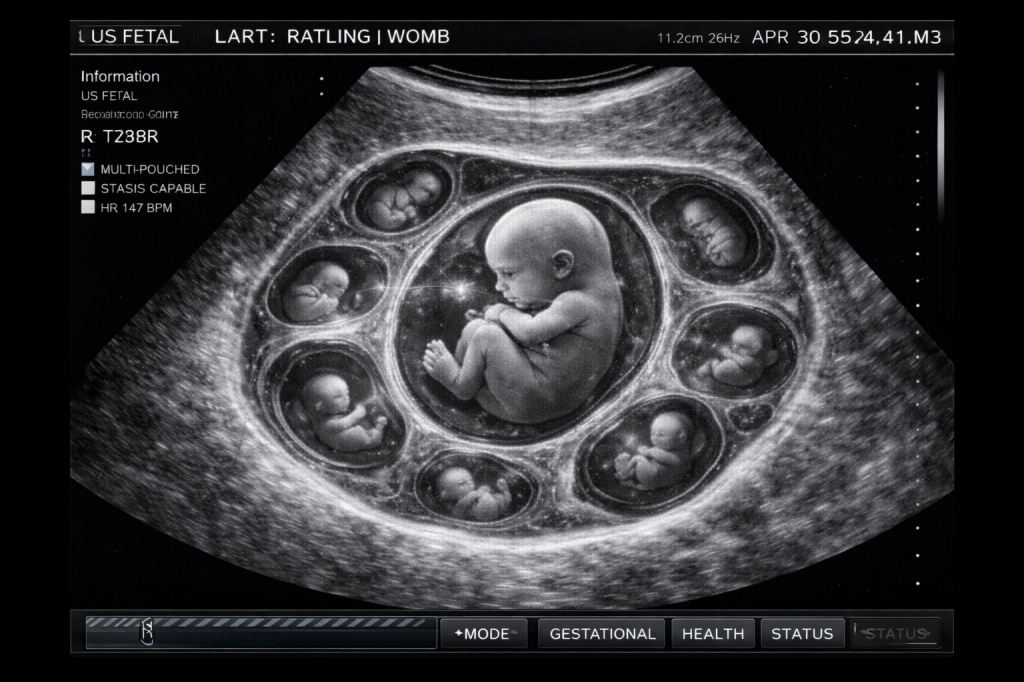
Ratling females possess the rare biological capability to simultaneously store multiple fertilized embryos within a multi-pouched womb structure. Unlike baseline human gestation, which typically supports one to two fetuses, Ratling physiology allows for the concurrent development of three to seven embryos under favorable conditions.
- The womb is structured in compartmentalized pouches, which can, at early stages, suspend or advance development of particular embryo as needed.
- Embryos can be held in stasis-like dormancy, permitting extended gestation if environmental stressors arise (e.g., famine, siege conditions, or toxic exposure).
Nutritional Triggering
The female body evaluates available caloric intake and environmental security factors. When food is abundant and stable, embryonic acceleration begins across all viable embryos, often resulting in cluster births—multiple children delivered over the course of a few months.
Selective Absorption & Embryonic Cull
In conditions of food scarcity or trauma, the Ratling female body initiates a natural embryonic cull, a grim but effective survival mechanism.
- Less-developed embryos are reabsorbed by the maternal system, their nutrients repurposed to support both the mother and the most viable fetuses.
- This process, known in Biologis lexicon as “nutritive resorption”, minimizes birthing risk and maximizes maternal survival.
A parallel is observed in certain Terran rodents and marsupials, but the Ratling’s system operates with higher metabolic discretion, suggesting long-range evolutionary drift.
Cultural and Imperial Implications
This reproductive adaptability allows Ratling populations to rapidly repopulate lost numbers, especially after planetary conquest or catastrophe. While Ratlings are scorned by many Imperial authorities, their rapid reproduction rate has made them self-sustaining auxiliary populations aboard long-range voidships and century spanning military campaigns.
Conclusion
Though often dismissed as gluttonous, idle, or unworthy, Ratlings are the Imperium’s fastest biologically multiplying abhuman strain. The wombs of Ratling mothers may be humble—but in their hidden folds, the next generations of Imperial snipers, cooks, and survivors quietly wait for the God-emperor to call them to servitude.
 Ignis Aeternus WH 40K campaign notes